Free Tracing Worksheets for Lines and Shapes Pre-writing practice with start dots, from easy to hard
Print tracing worksheets for the strokes children practise before letters: straight and diagonal lines, zigzags, waves, loops, spirals, circles, squares, triangles and more. Each path has a green start dot and arrow and a red end mark, with dotted rows that fade out and empty rows to try alone. US Letter or A4, PDF or print.
Make your tracing worksheets: pick the lines and shapes, then print
The page opens with the first strokes for ages 2–3: vertical and horizontal lines, circles and plus signs. Choose another set, tick the exact lines and shapes you want, set the difficulty and the row height, and print. The preview is exactly what the PDF, the PNG and your printout contain.
Page settings
Quick templates
Tracing worksheets: quick facts
Short answers for parents, preschool teachers and therapists choosing free pre-writing printables.
- Price
- Free, with no paid tier or download fee
- Account
- Not required
- Watermark
- None
- Export formats
- PDF (all pages in one file), PNG and direct print
- Paper sizes
- US Letter (8.5 × 11 in) and A4 (210 × 297 mm), portrait or landscape
- Supported sizes
- Three row heights (about 20, 24 and 30 mm); three difficulty levels; 1–6 empty rows after each pattern
- Privacy
- Runs in your browser; nothing you type is uploaded
- Languages
- 8 languages: English, Chinese, Spanish, Portuguese, French, German, Japanese, Korean
- Patterns
- 19 patterns: horizontal, vertical and diagonal lines, plus, X, zigzag, wave, arches, scallops, loops, spiral, circle, square, rectangle, triangle, diamond, star and heart
- Markers
- A green dot and arrow where each stroke starts, a red square where it ends; closed shapes such as circles have a start dot only
- Difficulty
- Easy (big, few repeats), medium, hard (small, many repeats) or easy to hard with three rows per pattern
- Tracing style
- Dotted path, outlined path to stay inside, or a thick light-gray path; with a solid black model row if you choose Model, trace, copy
- Suggested age
- About 2 to 5 years; the preset order follows the usual pre-writing sequence (vertical line, horizontal line, circle, plus, square, diagonals, X, triangle)
- Last updated
- October 17, 2026
Best for
- Parents of 2–5 year olds who want pre-writing practice before letters without paying or giving an email
- Preschool teachers and nursery staff who need a class set of line and shape tracing worksheets in minutes
- Occupational therapists and tutors who want to choose strokes, size and difficulty for one child
Not the best fit for
- Letters, numbers or names (use the alphabet tracing or name tracing pages instead)
- Colourful picture sheets with animals or characters; these pages are clean lines and shapes only
- A medical assessment of handwriting or motor skills; the ages quoted are guides, not a test
How it compares
- Fixed PDF packs (Preschool Play and Learn, Alien Schooler, Verandah Activities and similar)
- Good free sheets if the fixed pictures and sizes suit you, and many are well drawn. Here you choose the strokes, the size and the difficulty, and the pages carry no characters or branding.
- Subscription sites (ABCmouse, Education.com)
- Large libraries, but access to the full set usually sits behind a trial or account, and Education.com's own tracing generator only handles words. This page makes line and shape tracing worksheets without an account.
Why these tracing worksheets help children practise pre-writing strokes
Three things fixed line and shape printables leave out.
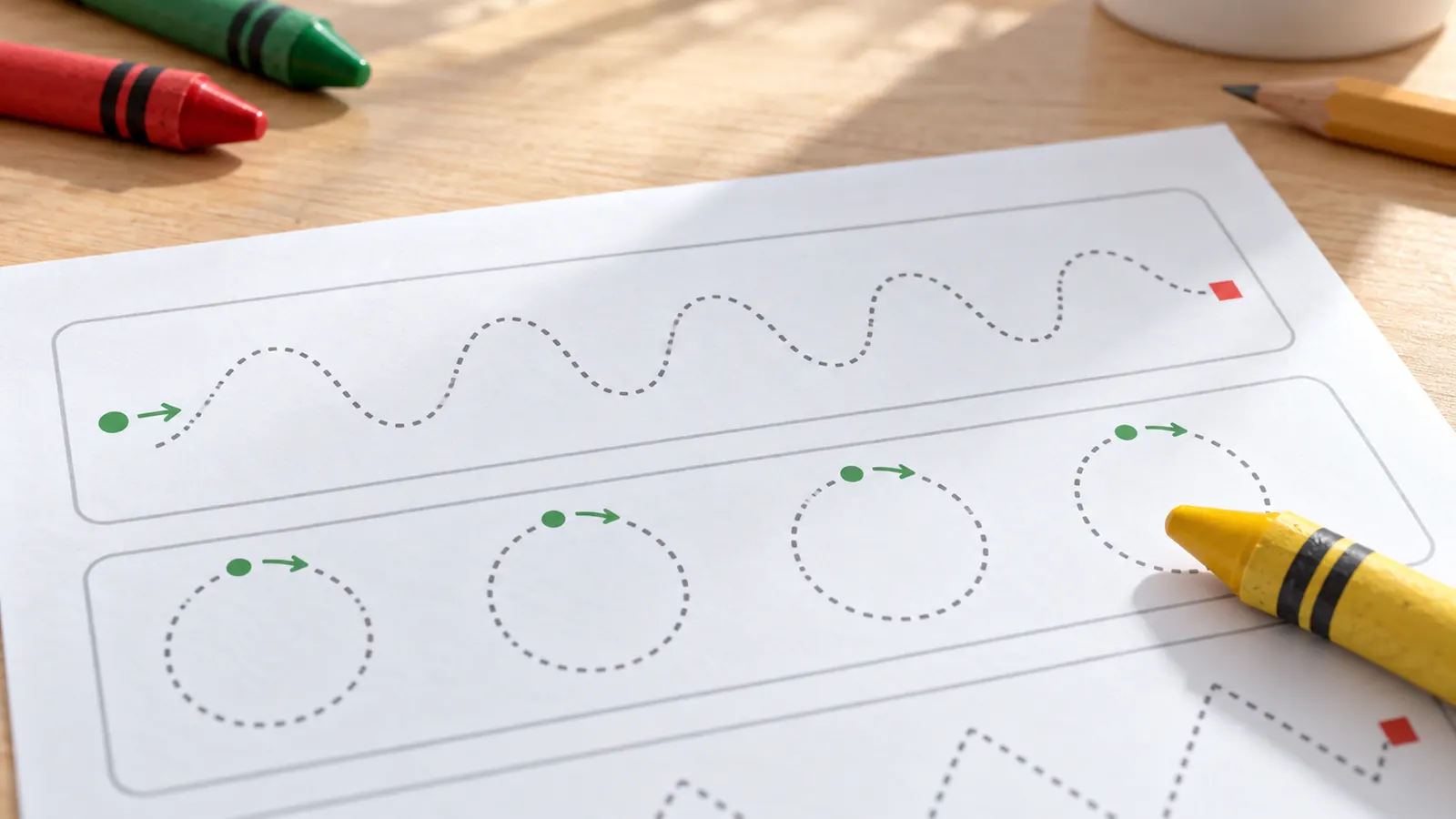
Start dots and end marks show where every stroke begins and stops
Each path has a green dot and a short arrow at the start and a red square at the end, so a child knows where to put the crayon and where to lift it. West Suffolk NHS therapists suggest tracing dotted lines "starting and stopping in the correct places". Switch the markers off for older children.
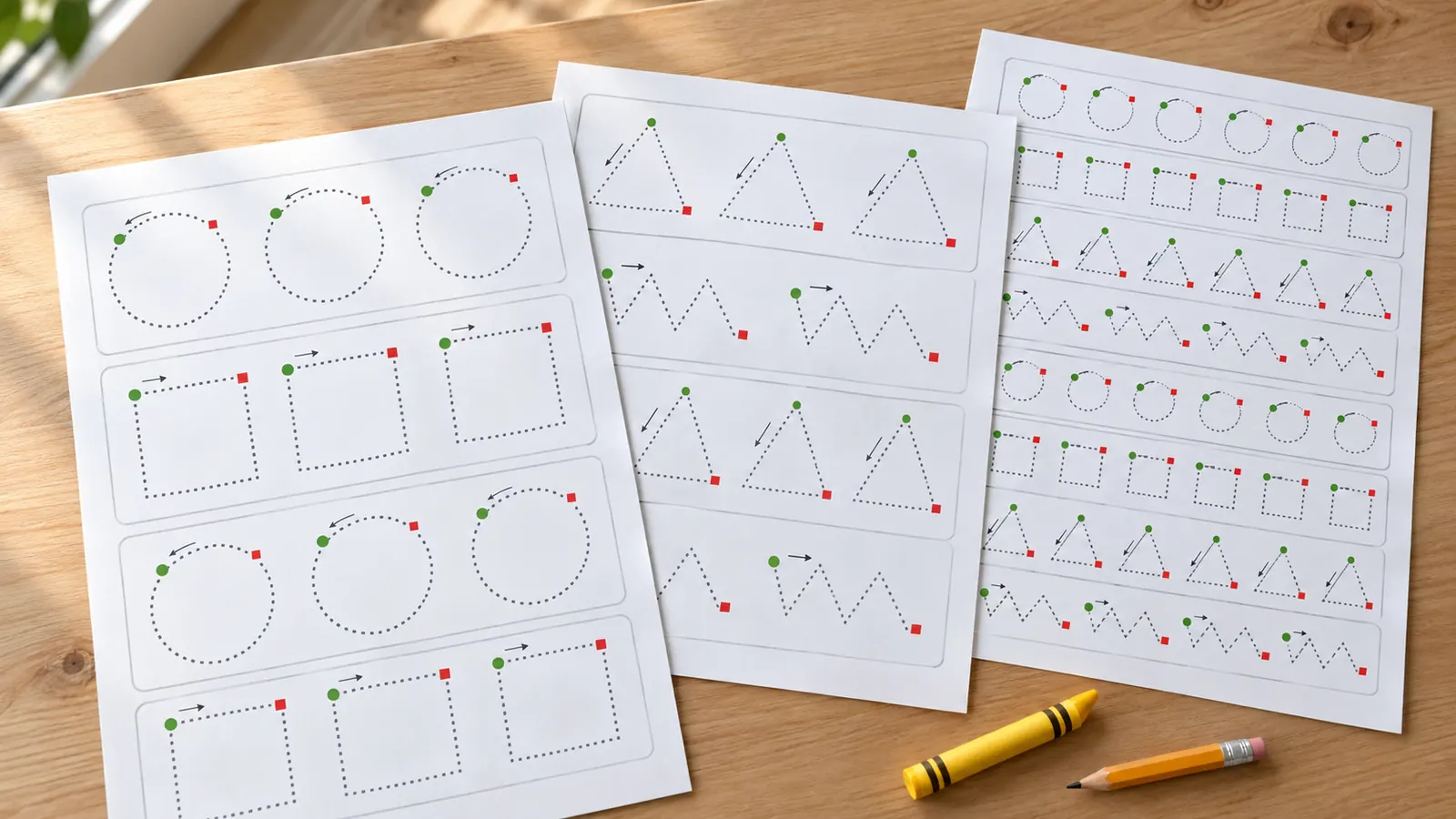
Three difficulty levels, or all three on one sheet
Easy shapes are big with few repeats; hard ones are small with many. Choose one level for the whole sheet, or pick Easy to hard to get every pattern three times in a row, from big to small. Occupational therapy leaflets also suggest narrowing the path gradually as control improves.
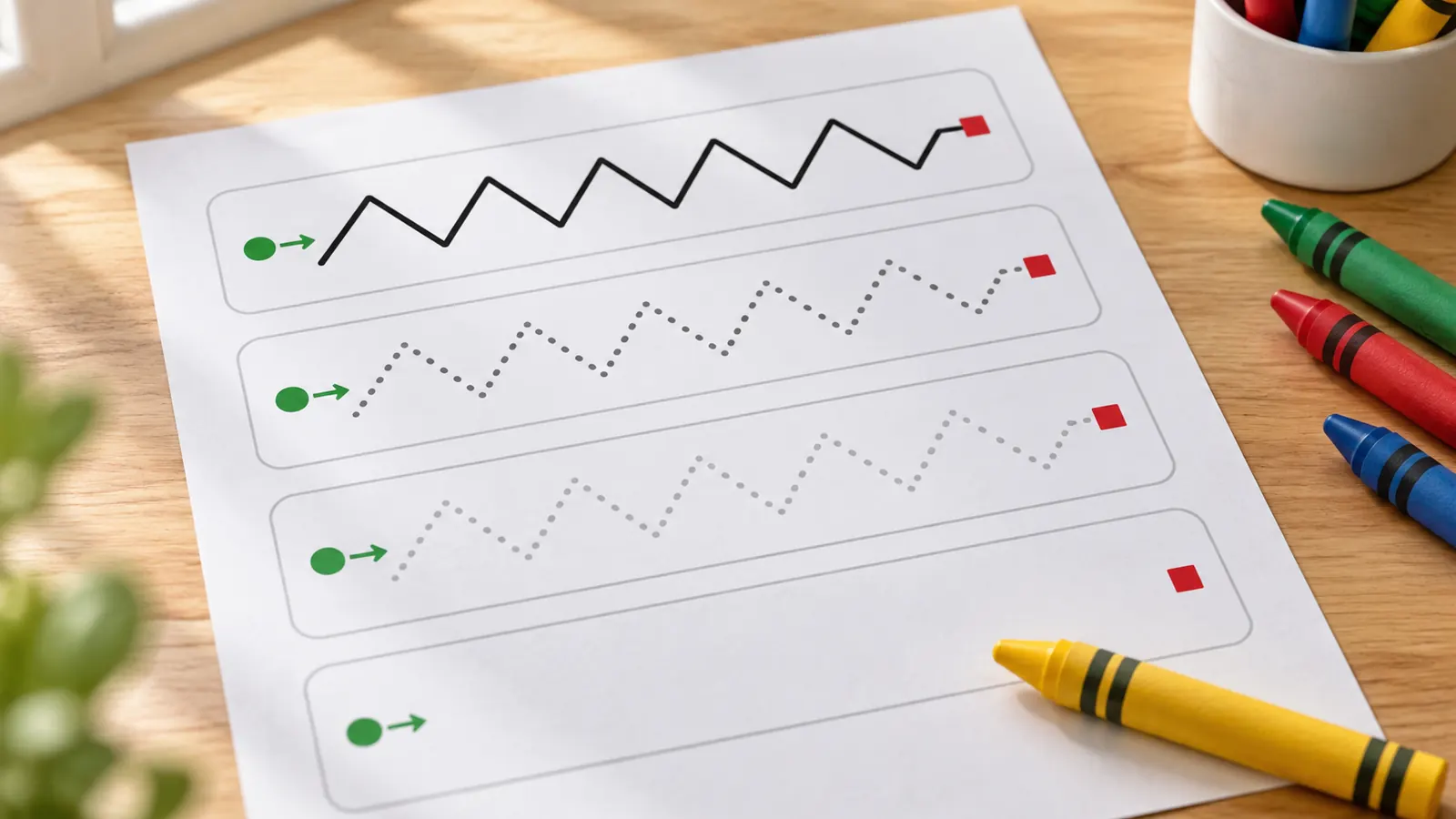
Model row, fading dotted rows and empty rows
Choose Model, trace, copy and every pattern starts with a black model, then dotted rows that get lighter, then empty rows with only the start dot. Teachers use this to move a child from tracing to copying without a visual cue. Pick the plain Trace and copy mode for one dotted row.
What you can set on your tracing worksheets
Every option stays editable until you download.
19 lines, curves and shapes
Tick any mix: horizontal, vertical and diagonal lines, plus and X, zigzag, wave, arches, scallops, loops, spiral, circle, square, rectangle, triangle, diamond, star and heart.
Ready-made sets
First strokes for ages 2–3, straight and diagonal lines, curves and loops, shapes, or the full pre-writing order. Edit the ticks to make your own.
Three tracing styles
A dotted path, an outlined path to stay inside, or a thick light-gray path, plus an optional black model row.
Three row heights
About 20, 24 or 30 mm per row. Larger rows suit the youngest children and thick crayons.
Letter, A4 and landscape
US Letter or A4, portrait or landscape, as PDF, PNG or a direct print.
Private by design
Everything runs in your browser. Nothing you choose is uploaded, and there is no account.
How to make tracing worksheets for lines and shapes in four steps
From a blank page to a printed pre-writing set in about a minute.
Choose a set of lines and shapes
Start with First strokes for ages 2–3 (vertical and horizontal lines, circle, plus), or pick Straight and diagonal lines, Curves and loops or Shapes. Tick or untick single patterns to make a custom set. The pre-writing order set follows the usual sequence: vertical line, horizontal line, circle, plus, square, diagonals, X, triangle.
- Teach two or three patterns at a time and untick the rest.
- Leave the diamond, star and heart for the end; they are harder and have no fixed age.
Set the difficulty, the style and the row height
Use Easy with large rows (about 30 mm) for 2–3 year olds, then move to Medium and Hard as control improves. Choose a dotted path for first tracing, an outlined path to practise staying inside the lines, or a thick light-gray path for a chunky crayon.
- Pick Easy to hard to practise each stroke three times, from big to small.
- Turn off the start dots and arrows once a child knows where to begin.
Check the preview and print at 100%
Choose US Letter or A4, then print with Actual size or 100% scale, not Fit to page. Plain 20 lb (US) or 80 gsm paper is fine. Slip a sheet into a plastic sleeve and use a dry-erase marker to trace the same page again and again.
- Print one page first if your printer scales pages.
- Download the PDF to keep a class set for next term.
Show the green dot, then step back
Point to the green dot, say "start here" and let the child trace to the red square with a short crayon or pencil. Move on to the lighter rows and then the empty row. Offer a vertical surface (a sheet taped to the wall) if the wrist tires quickly; NHS occupational therapy leaflets recommend large arm movements first.
- Five to ten minutes a day works better than one long session.
- Do not worry about the grip yet: most children settle into a tripod grip by about 6 or 7.
Tracing worksheets FAQ
Answers for parents, teachers and therapists.
Yes. There is no sign-up, no email, no watermark and no paid download. The pages are drawn in your browser and saved straight to your device as a PDF or PNG, so nothing you choose is uploaded.
Pre-writing skills are the building blocks children need before they can write: hand and finger strength, a comfortable pencil grasp, hand-eye coordination, and the pencil strokes that most letters and numbers are made of, such as vertical and horizontal lines, circles, crosses and diagonals. NHS occupational therapy services (for example Solihull, University Hospitals Birmingham) describe them in that order.
Lines and shapes. Occupational therapy leaflets list the usual order as vertical line, horizontal line, circle, plus, square, diagonal lines, X and triangle, and note that a circle is the same stroke as the letter o. Start with the First strokes set, then add straight and diagonal lines, curves and shapes before moving to the alphabet tracing worksheets.
Solihull NHS gives these ages as a guide only: a vertical line at 2–3 years, a horizontal line and a circle at about 3, a cross at about 4, a square at about 4½, an X at about 5 and a triangle at about 5¼. The CDC lists drawing a circle when shown how at 3 years. Every child is different, so follow readiness rather than the calendar.
NHS and NSW Health leaflets agree on the early order: vertical line, horizontal line, circle, plus (+), then diagonals and a square, then X and triangle. The pre-writing order set on this page follows it. Diamonds, stars and hearts are harder and no leaflet gives a firm age, so add them last.
The green dot with an arrow is where the stroke starts and which way to go; the red square is where it ends. Closed shapes such as circles and squares have a start dot only. Stroke direction differs between schools, so switch the markers off if your teacher uses another way.
Easy patterns are big with few repeats; Hard patterns are much smaller with more repeats. Easy to hard prints every pattern three times, big to small. In Model, trace, copy mode each pattern starts with a black model, then 2–6 dotted rows that get lighter, then 1–6 empty rows with only the start dot.
Dotted paths are the usual first step because the child joins dots. An outlined path is a lane to stay inside, which suits children who already trace well and are learning pencil control. The thick light-gray path works best with chunky crayons. Try each on one pattern and keep the one the child enjoys.
There is no clinical standard. Younger children usually do better with bigger, bolder patterns and fewer repeats, so start with the Large row height (about 30 mm) and Easy, then step down. Short, chunky crayons are easier to hold than long pencils for 2–3 year olds.
Yes. Choose US Letter or A4 in Page settings; the default follows your language. Print at 100% or Actual size so the rows keep their real height.
Not on this page, which is for lines and shapes. The alphabet tracing worksheets page makes A–Z sheets and the name tracing worksheet makes one page per child from a class list; both use the same start dots and fading rows.
Make your tracing worksheets now
Pick the lines and shapes, check the preview and print the whole set.
Free, no sign-up, no watermark, and nothing leaves your browser.
Ready for letters? Try the alphabet tracing worksheets or the name tracing worksheet next.