Free Alphabet Tracing Worksheets A–Z, one page per letter, with start arrows
Print alphabet tracing worksheets for all 26 letters in one go: capital and small letters together or on their own, a black model with green start dots and arrows, dotted rows that fade out, then empty lines to write alone. US Letter or A4, PDF or print.
Make your alphabet tracing worksheets: pick the letters and print
The page opens with the full A–Z set, capital and small letters, one page per letter. Change the alphabet, the case or the line size, or type your own letters. The preview is exactly what the PDF, the PNG and your printout contain.
Page settings
Quick templates
Alphabet tracing worksheets: quick facts
Short answers for parents, preschool teachers and anyone choosing free letter tracing printables.
- Price
- Free, with no paid tier or download fee
- Account
- Not required
- Watermark
- None
- Export formats
- PDF (all pages in one file), PNG and direct print
- Paper sizes
- US Letter (8.5 × 11 in) and A4 (210 × 297 mm), portrait or landscape
- Supported sizes
- Three line heights (about 20, 24 and 30 mm); up to 6 copies of each letter per row; 2–6 fading rows; 1–6 empty rows
- Privacy
- Runs in your browser; nothing you type is uploaded
- Languages
- 8 languages: English, Chinese, Spanish, Portuguese, French, German, Japanese, Korean
- Letters
- 26 letters: capital + small (Aa), capitals only or small letters only; or your own letters
- Pages
- One letter per page gives a 26-page PDF; the compact preset puts two letters on a page for 13 pages
- Rows on each page
- One black model row with start dots and arrows, then 2–6 dotted rows that fade from dark to light, then 1–6 empty rows
- Letter order
- A–Z, by stroke shape (L F E H T I first) or by formation family (curly c, one-armed n, zig-zag v)
- Letter shapes
- Upright or slanted school print (Andika font); not joined-up cursive
- Last updated
- October 17, 2026
Best for
- Parents of 3–6 year olds who want a full A–Z set without paying or giving an email
- Preschool and kindergarten teachers who need a class set in minutes
- Tutors and occupational therapists who want to fade the visual support step by step
Not the best fit for
- Cursive or joined-up writing (the letters are unjoined print)
- Pictures or colouring pages beside each letter; these sheets are lines only
- Children who cannot yet hold a crayon with their fingertips; start with pre-writing strokes first
How it compares
- SplashLearn, K5 Learning and ABCmouse
- Polished fixed sets that are good for screen play and ready-made PDFs, but they push accounts or a membership, and you cannot change the case, order or line size. Here you choose all three and download once.
- Free blog PDFs and Etsy bundles
- Fine if the fixed design suits you, but some ask for an email and paid sets add up. This page makes the same A–Z pages in a minute, with start arrows and fading rows.
Why these alphabet tracing worksheets help children learn to write letters
Three things fixed A–Z printables leave out.
Start dots and arrows show where every letter begins
The black model row has a green dot where each letter starts and a short arrow for the first direction, so children stop guessing and adults can say "start at the dot". Stroke order differs between schools, so switch the arrows off if yours teaches another way.
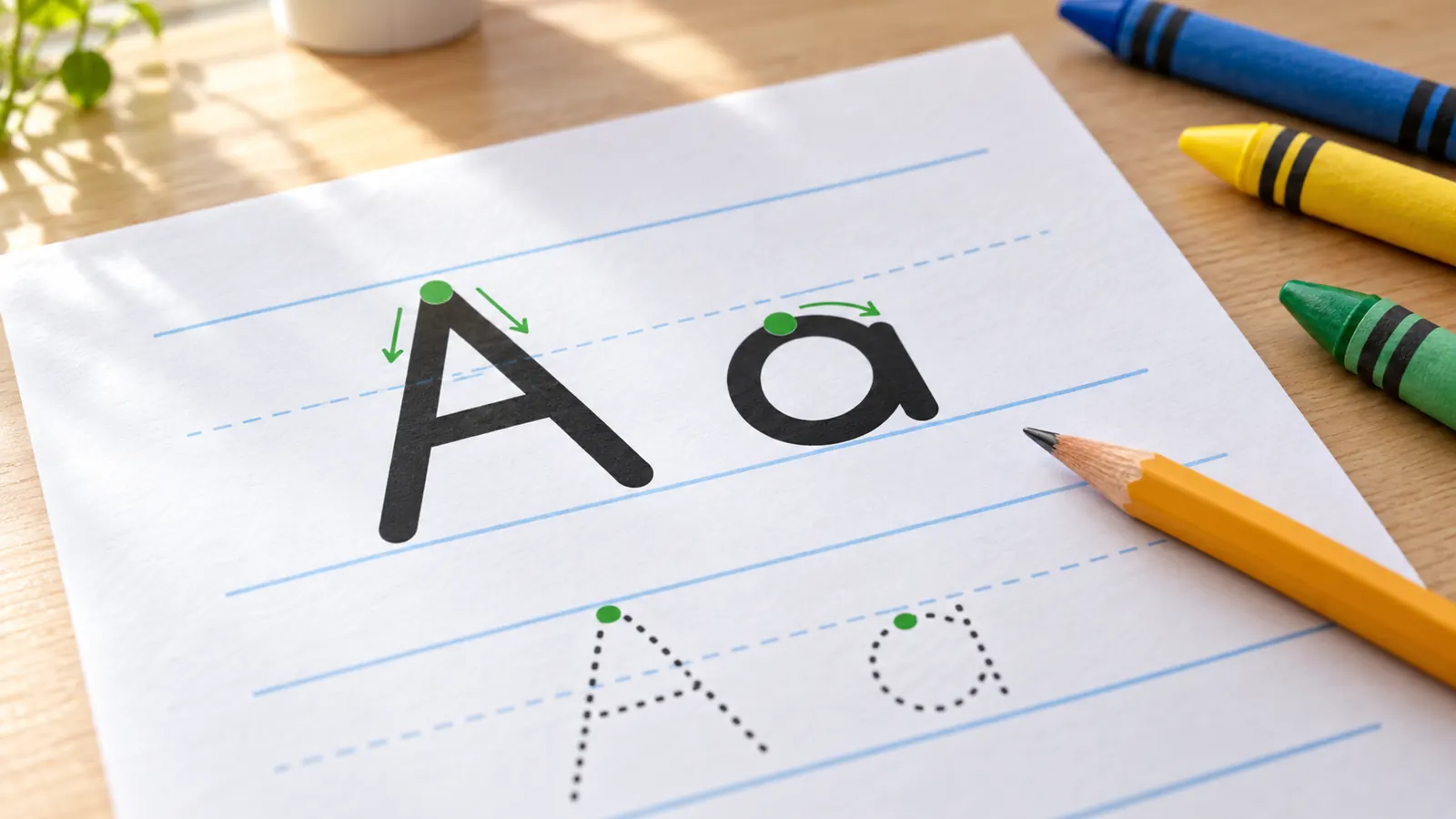
Capitals, small letters or both on one line
Choose Aa pairs, capitals only or small letters only. Many teachers start with capitals at about age 3–4 because they have no descenders, then add small letters. The same tool covers both steps, so one set grows with the child.
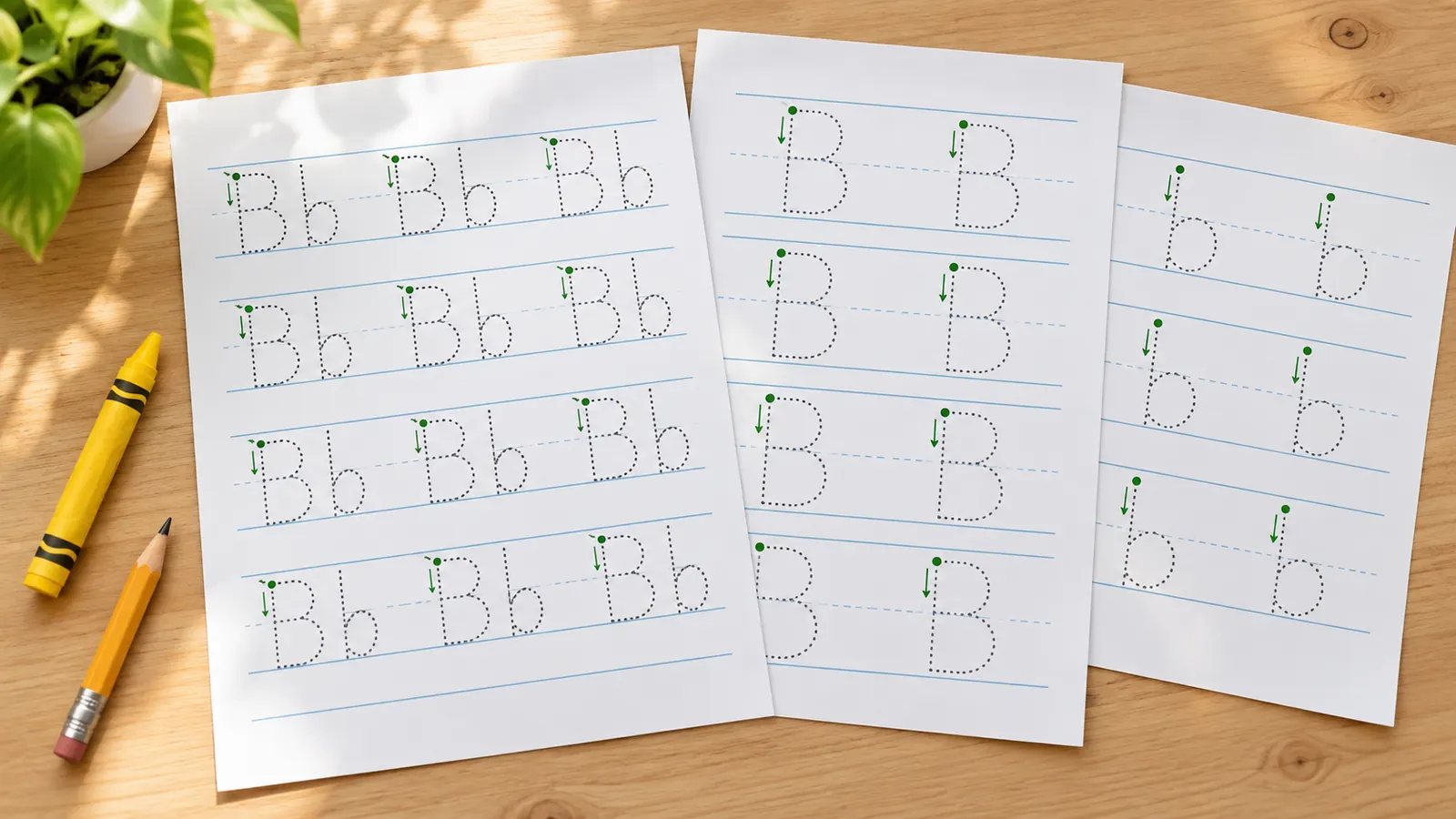
All 26 letters at once, in a teaching order you choose
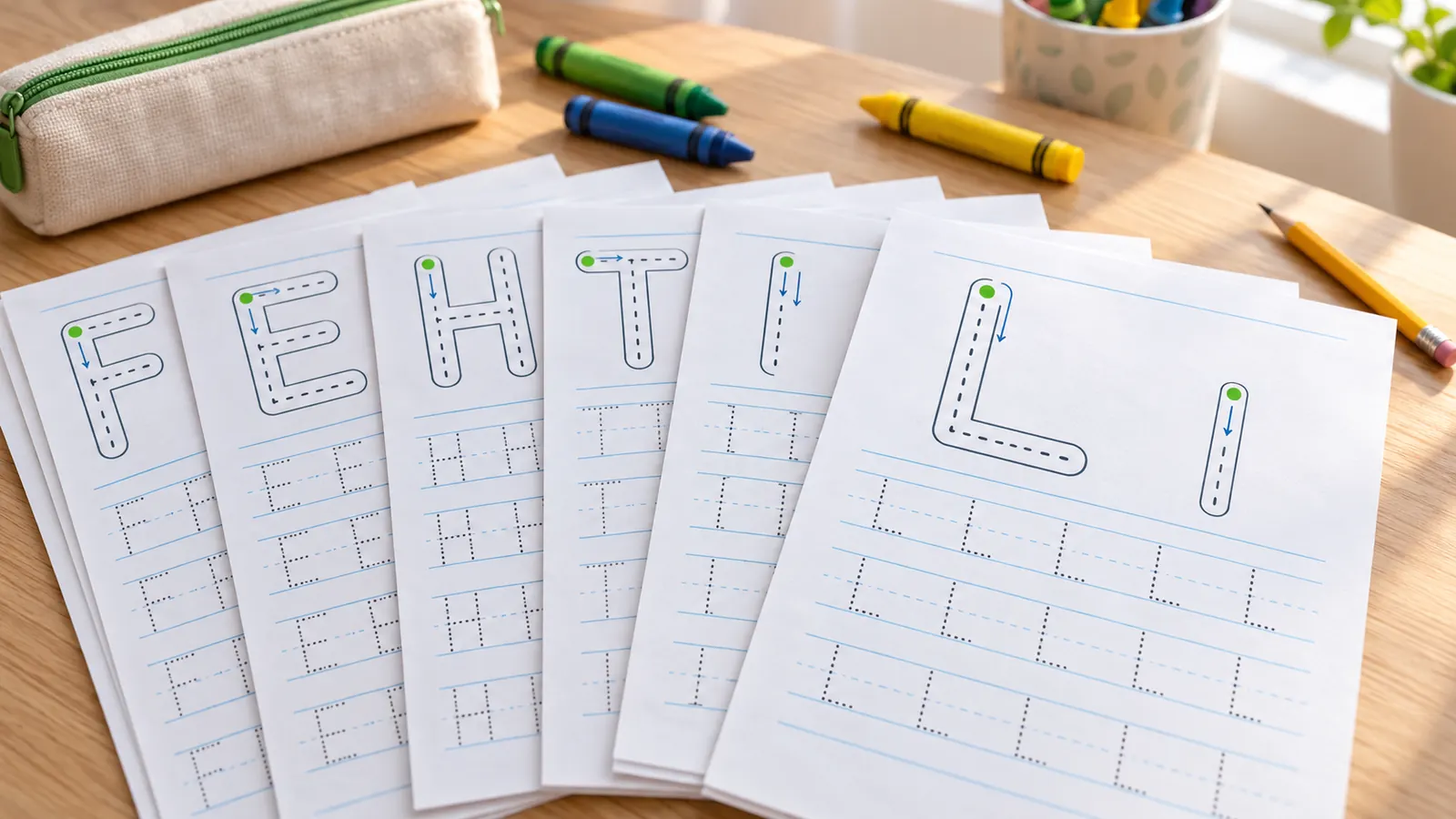
Print A–Z in one PDF with a letter on every page, or use the compact preset for two letters per page. You can also teach by stroke shape, starting with the straight-line capitals L F E H T I, or by formation family, so letters that move the same way are practised together.
What you can set on your alphabet tracing worksheets
Every option stays editable until you download.
Any letters you like
Start from A–Z or type your own list, one letter per line: just the letters in a name, a spelling list or this week's sounds.
Letter case
Capital and small together (Aa), capitals only or small letters only.
Three letter orders
Alphabetical, by stroke shape, or by formation family. Edit the list to match your own scheme.
Three line heights
About 20, 24 or 30 mm between the top and bottom lines. Pick bigger lines for the youngest children.
Letter, A4 and landscape
US Letter or A4, portrait or landscape, as PDF, PNG or a direct print.
Private by design
Everything runs in your browser. Nothing you type is uploaded, and there is no account.
How to make alphabet tracing worksheets in four steps
From a blank page to a printed A–Z set in about a minute.
Choose the alphabet and the letter order
In the Alphabet and order box, pick A to Z, stroke-shape order or formation-family order. A common stroke-shape order starts with the straight-line capitals L F E H T I, then the round letters, then the diagonals. You can also type your own letters, one per line.
- Teach a few letters at a time; delete the lines you do not need.
- Type your own list for a child's name or this week's spelling letters.
Pick capitals, small letters or both
Capitals are the usual first step for ages 3–4 because they have no descenders, and small letters follow around 4–5. Choose Capital + small to practise both on one line, with larger lines and 3 fading rows for the youngest.
- Handwriting Without Tears starts with capitals; many UK schools teach small letters first.
- Turn off the start arrows if your school teaches a different stroke order.
Check the preview and print at 100%
Choose US Letter or A4, then print with Actual size or 100% scale, not Fit to page. Plain 20 lb (US) or 80 gsm paper is fine, and a laminated sheet with a dry-erase marker lets a child trace the same letter again and again.
- Print one page first if your printer scales pages.
- Download the PDF to keep a class set for next term.
Show the first dot, then step back
Point to the green dot, say "start here" and let the child trace the dotted letters with a pencil or crayon. Move to the lighter rows as confidence grows and finish with the empty lines. Start tracing only when the child can hold a pencil with the fingertips; until then, practise lines and curves.
- Five to ten minutes a day works better than one long session.
- Say the letter's sound as you trace it to link shape and sound.
Alphabet tracing worksheets FAQ
Answers for parents, teachers and tutors.
Yes. There is no sign-up, no email, no watermark and no paid download. The pages are drawn in your browser and saved straight to your device as a PDF or PNG, so nothing you type is uploaded.
Keep the full alphabet, leave One page per letter on and download the PDF: you get 26 pages. For a smaller stack choose the compact preset, which puts two letters on each page for 13 pages. Print one page first to check the size, then print the set.
There is no single right order. One widely used Handwriting Without Tears-style order groups capitals by stroke: straight-line letters L F E H T I, then round letters, then diagonals. Jolly Phonics (UK) teaches sounds in groups starting s a t i p n. Pick the order your child's school uses; you can reorder the list.
Experts disagree and research is inconclusive, so the tool offers all three: Aa pairs, capitals only and small letters only. Handwriting Without Tears starts with capitals because they have no retracing or descenders, while many UK schools start with small letters. Follow your school.
Tracing lines and curves comes first, then letters. Many children are ready for capitals around 3–4 and small letters around 4–5, but readiness matters more than age. A child who can hold a pencil with a tripod grip, typically around 4–6, usually finds letter tracing easier.
The dot marks where each letter starts and the arrow shows the first direction. Stroke order varies between curricula, so treat it as a starting point and switch the arrows off if your school teaches something else.
Each page starts with a black model, then dotted rows that get lighter, then empty lines. You choose 2 to 6 fading rows and 1 to 6 empty lines. Fading the visual support gradually is how teachers move a child from tracing to writing without a model.
There is no clinical standard. US kindergarten handwriting paper is commonly ruled about ¾ to 1 inch (19–25 mm), and 1⅛ inch paper is sold for pre-K. This tool offers about 20, 24 and 30 mm; start with the largest for 3–4 year olds and step down.
You can choose upright print, similar to Zaner-Bloser's upright style, or a slanted print closer to D'Nealian. The letter shapes are the free Andika school font, not the D'Nealian or Zaner-Bloser typefaces, so exit strokes and joined cursive are not included.
Yes. Choose US Letter or A4 in Page settings; the default follows your language. Print at 100% or Actual size so the lines keep their real height.
Make your alphabet tracing worksheets now
Pick the letters, check the preview and print the whole A–Z set.
Free, no sign-up, no watermark, and nothing leaves your browser.
Need names instead? The name tracing worksheet makes one page per child from a class list.