Free Cursive Worksheets You Can Type Yourself Joined letters, your words, fading practice rows
Make cursive worksheets for kids and adults in a minute: pick the cursive alphabet, connecting letters, words or sentences, or type your own text. Each line gets a black model, lighter tracing rows and empty lines to write alone. US Letter or A4, PDF or print.
Make your cursive worksheets: choose a preset or type your text
The page opens with the cursive alphabet. Switch to connecting letters, words, sentences or a name, or type your own lines. Pick one of seven school cursive styles, the line height and the number of fading rows. The preview is exactly what the PDF, the PNG and your printout contain.
The styles use the open-source Playwrite fonts, modelled on national school handwriting. They are close to, but not identical with, any single school's copybook.
Page settings
Quick templates
Loading the writing font. Printing and downloads will be available when it is ready.
Cursive worksheets: quick facts
Short answers for parents, teachers, homeschoolers and adults who want to improve their handwriting.
- Price
- Free, with no paid tier or download fee
- Account
- Not required
- Watermark
- None
- Export formats
- PDF (all pages in one file), PNG and direct print
- Paper sizes
- US Letter (8.5 × 11 in) and A4 (210 × 297 mm), portrait or landscape
- Supported sizes
- Three line heights; a four-line guide with headline, dashed midline, baseline and descender line; 2–6 fading rows; 1–6 empty rows
- Privacy
- Runs in your browser; nothing you type is uploaded
- Languages
- 8 languages: English, Chinese, Spanish, Portuguese, French, German, Japanese, Korean
- Presets
- Cursive alphabet a–z and A–Z, small letters by shape, capitals, two sets of connecting letters, words, sentences and a name
- Your own text
- Type letters, words, sentences or a class list, one per line; letters inside a word are joined, letters separated by spaces stay apart
- Cursive styles
- Seven school styles: US, Spanish, Brazilian, French, and three German (LA, SAS, VA), from the open-source Playwrite fonts
- Tracing styles
- Light gray letters, dotted letters or outline letters that fade out row by row
- Not included
- No stroke-order arrows and no D'Nealian or Zaner-Bloser typefaces; letter shapes are close to school models but not identical
- Last updated
- October 17, 2026
Best for
- Parents and teachers of children in about grades 2–4 who are starting joined writing
- Homeschoolers who want custom words, spelling lists or Bible and poem lines in cursive
- Adults who want to improve their handwriting or learn to sign and read cursive
Not the best fit for
- Pre-writing strokes and print letters (use the tracing worksheets and alphabet tracing pages)
- Matching one exact school copybook letter by letter, such as D'Nealian or Zaner-Bloser
- Learning stroke order from arrows; the sheets show finished letters to trace, not how each stroke starts
How it compares
- K5 Learning and Superstar Worksheets
- Well made fixed sets by letter, join and sentence, but you cannot type your own text, and some pages are for members. Here every line is yours and nothing needs an account.
- MyCursive and handwriting generators
- Quick generators for a few lines of text, usually without tracing rows, presets or a choice of style. This page adds fading rows, presets and seven cursive styles.
- Twinkl, Teachers Pay Teachers and Etsy
- Polished packs when the fixed design fits, but you pay or sign up, and you cannot change a word. Use those for themed art and this page for your own words.
Why these cursive worksheets work for kids and adults
Three things fixed cursive printables leave out.
Real joined cursive from any text you type
Type a name, a spelling list or a favourite sentence and the letters join the way they do on a copybook page. Fixed cursive worksheets stop at the alphabet and a handful of sentences. Here the same practice covers your child's name, this week's words or a poem.
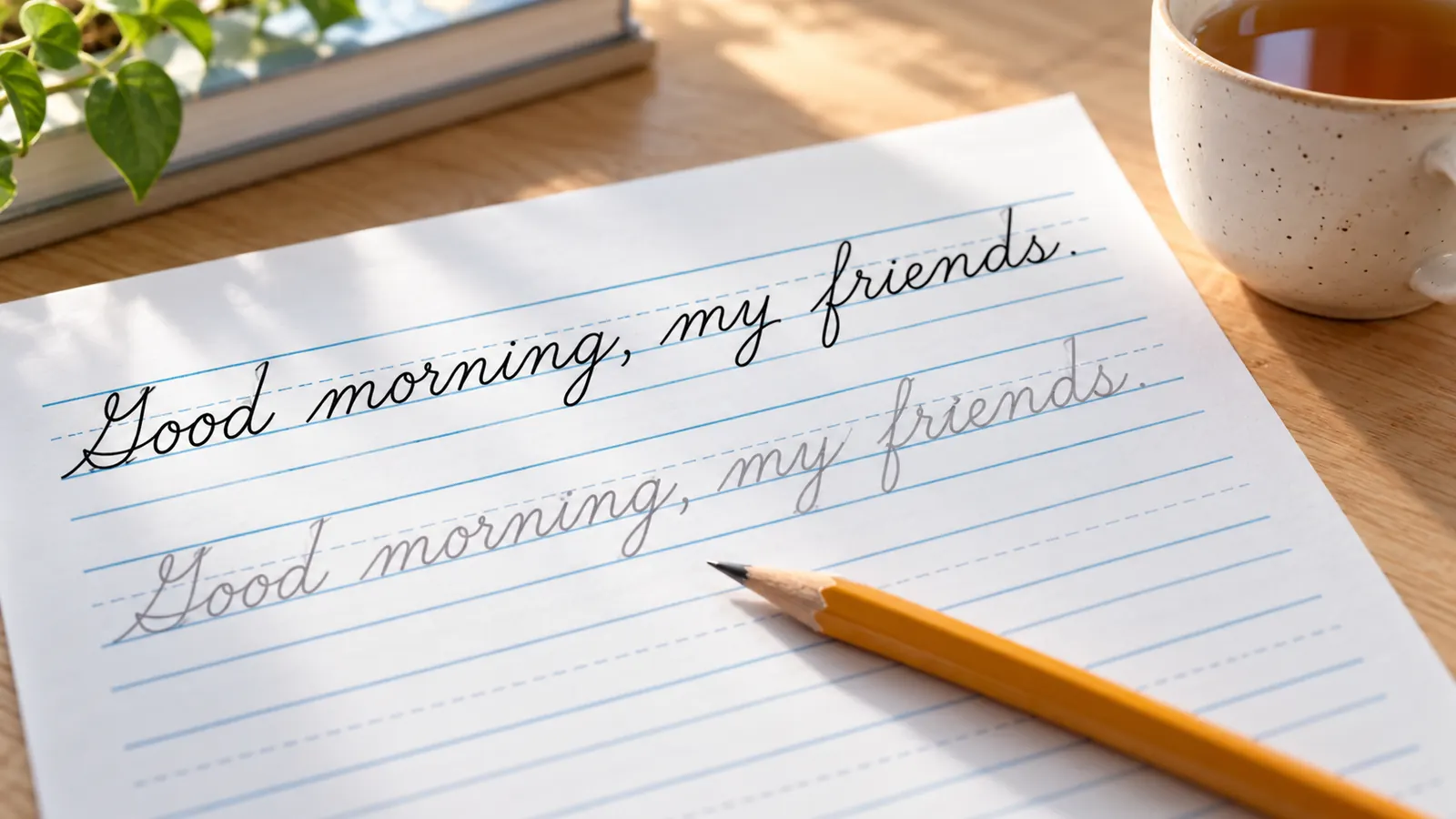
Model, fading rows, then empty lines
Every line starts with a black model, then gray rows that get lighter, then empty writing lines. Fading the support step by step is how learners move from tracing to writing from memory. Choose 2 to 6 fading rows and 1 to 6 empty lines, or switch to dotted or outline letters.
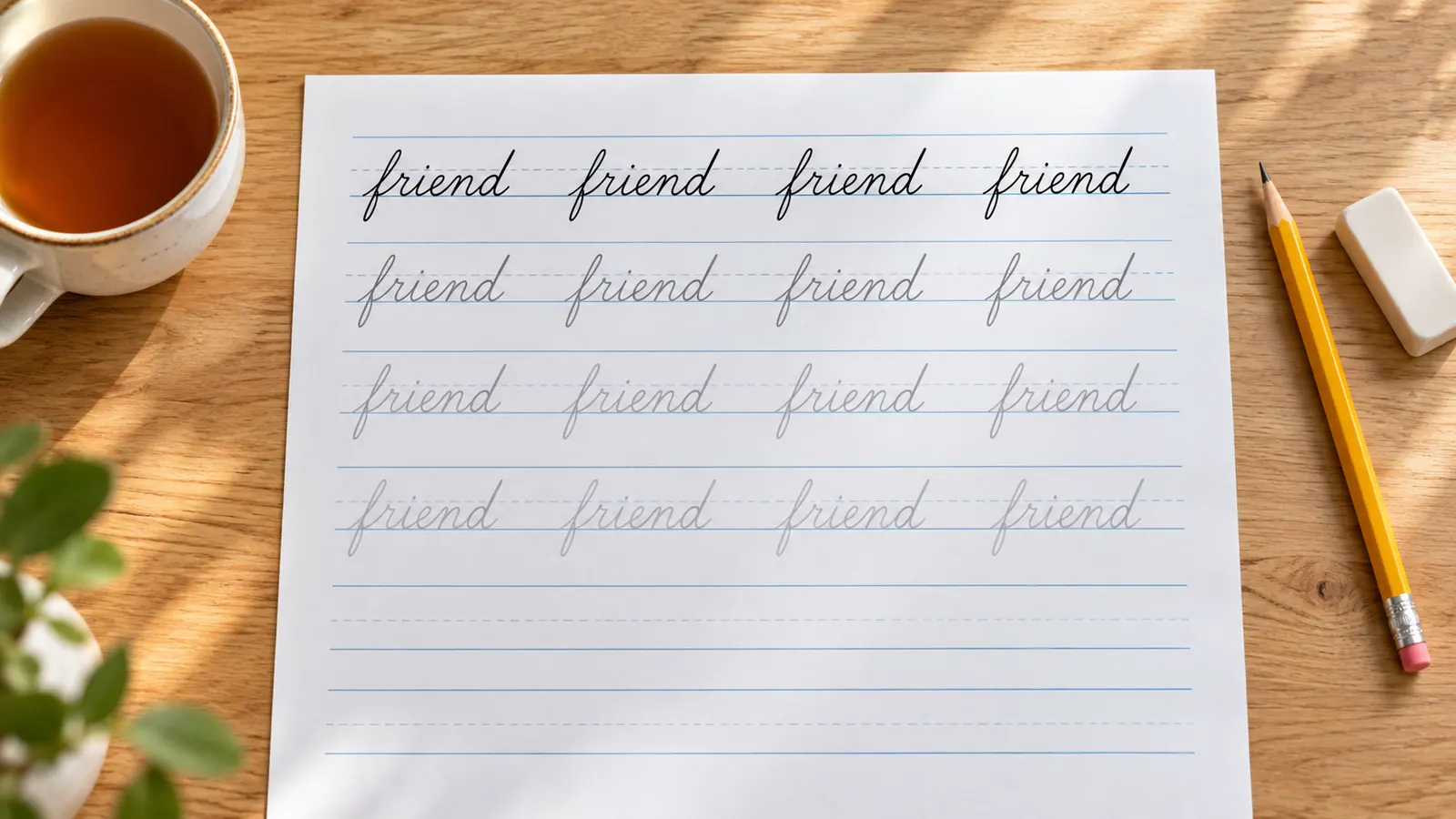
Connecting letters before whole words
Joins are where most learners get stuck, so two ready-made sets practise short joins like an, el and it, then joins that end in a vowel like ca, de and go. Move on to words and sentences once the joins feel smooth, and pick the school style that matches your class.
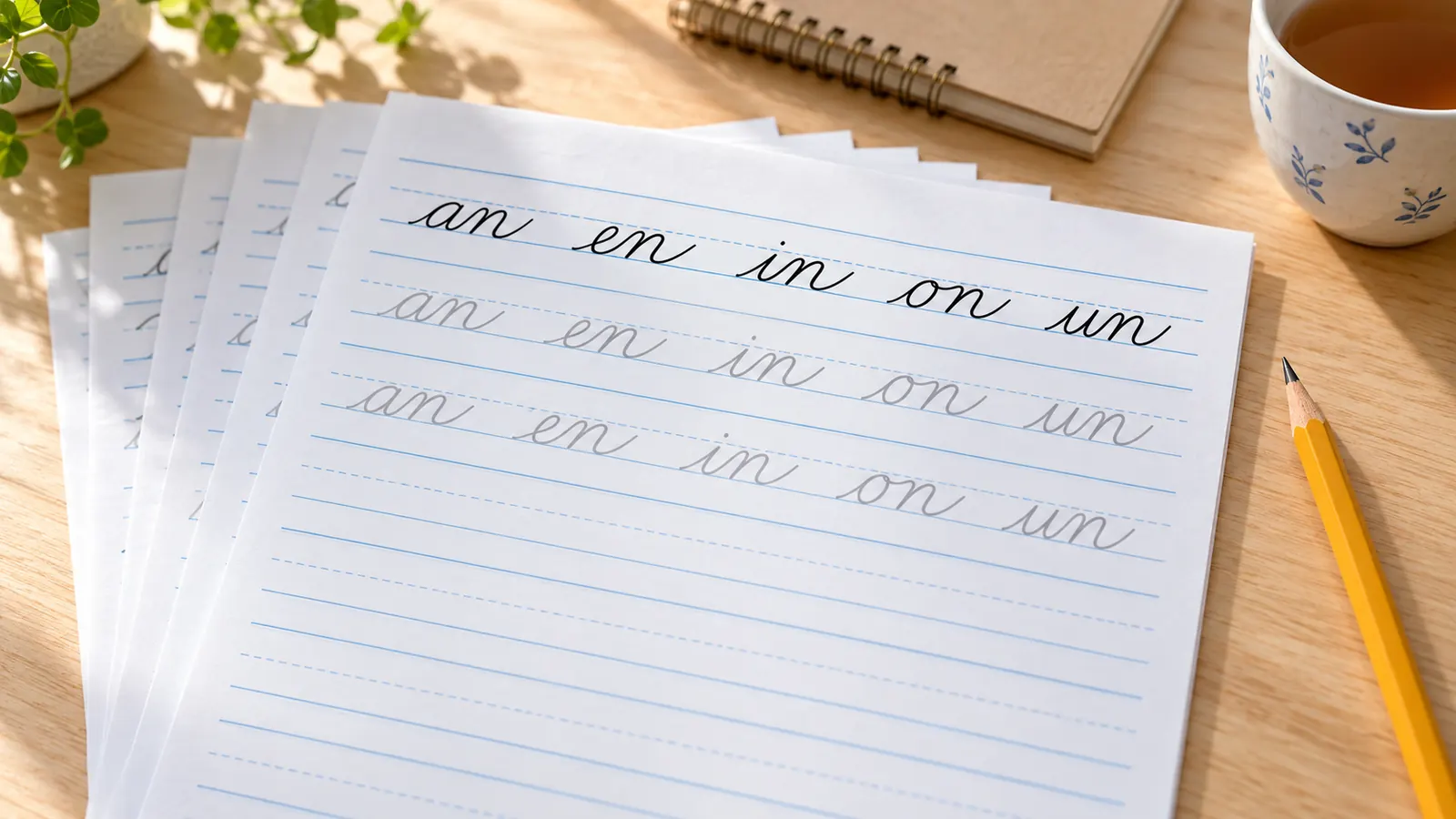
What you can set on your cursive worksheets
Every option stays editable until you download.
Your own text
Letters, words, sentences or a class list, one line per row. Long sentences wrap onto the next row.
Eight presets
Alphabet, small letters by shape, capitals, two sets of joins, words, sentences and a name.
Seven cursive styles
US, Spanish, Brazilian, French and three German school styles; each has its own letter shapes and line proportions.
Three line heights
Small, medium or large lines; the guide shows the headline, a dashed midline, the baseline and the descender line.
Letter, A4 and landscape
US Letter or A4, portrait or landscape, as PDF, PNG or a direct print.
Private by design
Everything runs in your browser. Nothing you type is uploaded, and there is no account.
How to make cursive worksheets in four steps
From a blank page to a printed cursive practice sheet in about a minute.
Pick a preset or type your own cursive text
Open Presets and choose the cursive alphabet, small letters by shape, capitals, connecting letters, words, sentences or a name. Or type your own lines. Letters inside a word are joined; letters separated by spaces stay separate, which is handy for alphabet rows.
- One line per row: put each word, sentence or name on its own line.
- Type a class list and every name gets its own practice rows.
Choose the cursive style and the fading rows
Pick the school cursive style that matches your class and the number of fading rows. Many programs teach lowercase by letter shape, then capitals, then joins, then words and sentences. Handwriting Without Tears, for example, puts capitals last.
- There is no single standard order, so reorder the lines to match your program.
- Choose dotted or outline letters if gray fill is hard to see on your printer.
Check the preview and print at 100%
Choose US Letter or A4, then print with Actual size or 100% scale, not Fit to page. Plain 20 lb or 80 gsm paper is fine. A laminated copy and a dry-erase marker lets a learner trace the same line again and again.
- Print one page first if your printer scales pages.
- Download the PDF to keep a set for next term.
Trace, then write on the empty lines
Copy the black model, trace the lighter rows and finish on the empty lines. Keep sessions short, five to ten minutes a day, and sit with the paper straight in front of you. Move to words and sentences once the joins look steady.
- Left-handed writers can tilt the paper to the right.
- Check that letters sit on the baseline and tall letters reach the headline.
Cursive worksheets FAQ
Answers for parents, teachers and adults.
Yes. There is no sign-up, no email, no watermark and no paid download. The pages are drawn in your browser and saved straight to your device as a PDF or PNG, so nothing you type is uploaded.
Yes. Type letters, words, sentences or a list of names, one per line. Letters inside a word are joined automatically, long sentences wrap onto the next row, and every line gets a model row, fading rows and empty lines.
Open the Your name in cursive preset, replace the sample with your child's name and print. You can type several names, one per line, and tick One line per page to get a separate sheet for every child.
There is no single standard. Handwriting Without Tears groups lowercase letters by shape and teaches capitals last, while other programs group by the first stroke or go alphabetically. The small-letters preset groups round, loop, hill and other letters, and you can reorder the lines.
Schools in the US usually introduce cursive in grade 2 or 3, about ages 7 to 9, after print is secure; Zaner-Bloser and Handwriting Without Tears both start joined writing around then. In England, children start joining letters in Year 2 (age 6 to 7). Readiness matters more than the exact age.
It depends on where you live. The Common Core standards do not require cursive, but states can add it, and trackers count roughly two dozen US states that now require it. In England, the National Curriculum expects joined handwriting to be the norm by lower key stage 2. Check your state or school.
Research has not found a clear speed advantage. A study of about 600 students in grades 4 to 9 found no difference in speed or legibility between print and cursive, and students who mixed both styles wrote fastest. Cursive is worth learning for reading handwritten documents and for a fluent signature.
Joins are small strokes that carry on from the end of one letter into the next. Start with the two connecting-letters presets, which practise vowel-to-letter joins such as an, el and it and letter-to-vowel joins such as ca, de and go, then move on to words.
No. The sheets use the open-source Playwrite fonts, modelled on national school handwriting, so the shapes are close to a school copybook but not identical to D'Nealian or Zaner-Bloser. If your school requires one exact model, use these sheets for extra practice and check the model with the teacher.
Yes to both. Adults often use cursive worksheets to improve handwriting, learn a signature or read old letters. Choose US Letter or A4 in Page settings; the default follows your language. Print at 100% so the lines keep their real height.
Make your cursive worksheets now
Pick a preset or type your text, check the preview and print.
Free, no sign-up, no watermark, and nothing leaves your browser.
Need print letters first? The alphabet tracing and name tracing worksheets start with unjoined letters.