Printable Guide
Sight Words List: Dolch and Fry Words by Grade, Free to Print
A sight words list for every level: all 220 Dolch words by grade, the Fry first 100, how they differ, how many to teach a day and how to print practice sheets.
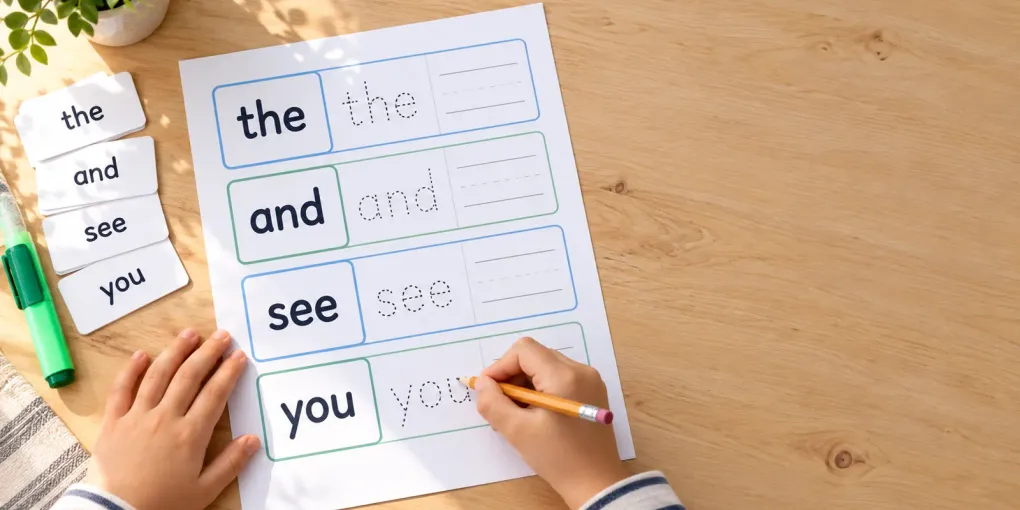
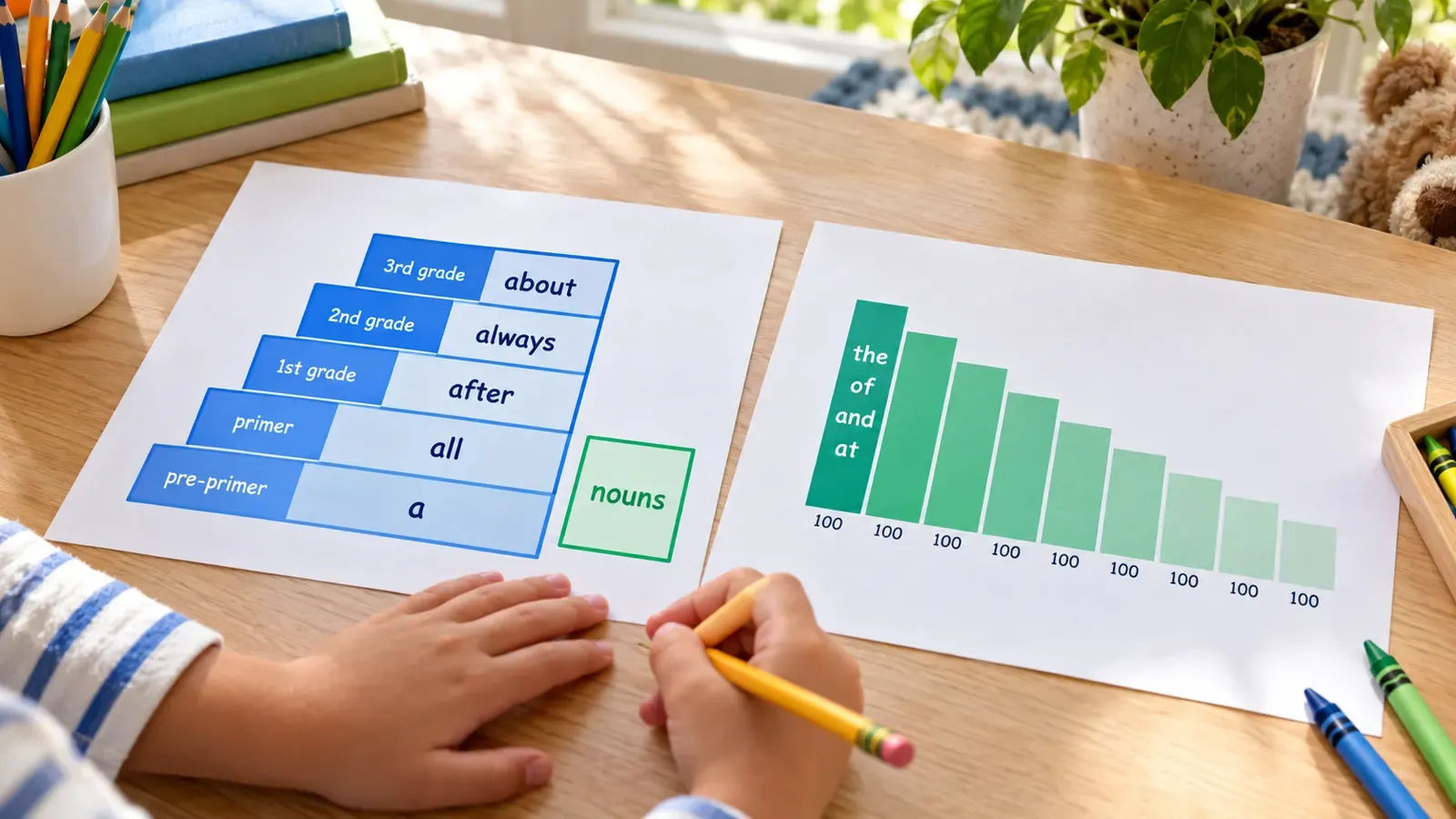
Short answer: the two sight words lists most teachers use are the Dolch list (220 common words in five levels, from pre-primer to 3rd grade, plus 95 nouns) and the Fry list (the 1,000 most frequent words in English, ranked by how often they appear and taught 100 at a time). Start with Dolch pre-primer or the Fry first 100, teach about five words at a time for a few minutes a day, and always connect the words to real reading.
Most pages that rank for a sight words list are just a list. They rarely tell you which list to choose, what grade each one fits, how many words to teach in a day, or why some words are easy to sound out and others are not. This guide gives you the full Dolch lists by level, the Fry first 100, a comparison, a simple teaching routine and a free way to print practice sheets. Updated 2026-10-18.
What is a sight words list?
A sight word is a word a reader recognises instantly, without sounding it out. Literacy researcher Timothy Shanahan puts it this way: sight words are “words the students can recognize seemingly instantaneously… no matter how or why that word was learned” (Shanahan on Literacy). A sight words list is a set of words chosen because children meet them over and over in early books.
The terms get mixed up, so here is how they relate:
| Term | What it means |
|---|---|
| Sight word | Any word read instantly, whatever its spelling |
| High-frequency word | A word that appears very often in print; can be regular (can) or irregular (said) |
| Decodable word | A word you can read by sounding out its letters (sit, jump) |
| Heart word / irregular word | A word with a part that does not follow the usual rules (said, the); the tricky part is learned “by heart” |
| Common exception words | The England National Curriculum term for words with unusual spelling-sound links (gov.uk) |
Many sight words are not odd at all. Shanahan found that 55 of the Fry first 100 words are entirely decodable and another 42 are at least partly decodable (Shanahan on Literacy). That is why good teaching uses sounds as well as repetition.
Dolch sight words list by grade
Edward William Dolch published his basic sight vocabulary in 1936 and added a noun list in his 1948 book Problems in Reading (Wikipedia). The 220 “service words” (no nouns) are sorted into five levels. Grade levels are a common convention, not an official standard: the Dolch list is “merely a recommendation” and districts group the words differently (K12Reader). Counts vary by one or two words between sources; these follow the common 40 / 52 / 41 / 46 / 41 split.
Pre-primer (40 words, pre-K to kindergarten)
a, and, away, big, blue, can, come, down, find, for, funny, go, help, here, I, in, is, it, jump, little, look, make, me, my, not, one, play, red, run, said, see, the, three, to, two, up, we, where, yellow, you
Primer (52 words, kindergarten)
all, am, are, at, ate, be, black, brown, but, came, did, do, eat, four, get, good, have, he, into, like, must, new, no, now, on, our, out, please, pretty, ran, ride, saw, say, she, so, soon, that, there, they, this, too, under, want, was, well, went, what, white, who, will, with, yes
1st grade (41 words)
after, again, an, any, as, ask, by, could, every, fly, from, give, going, had, has, her, him, his, how, just, know, let, live, may, of, old, once, open, over, put, round, some, stop, take, thank, them, then, think, walk, were, when
2nd grade (46 words)
always, around, because, been, before, best, both, buy, call, cold, does, don’t, fast, first, five, found, gave, goes, green, its, made, many, off, or, pull, read, right, sing, sit, sleep, tell, their, these, those, upon, us, use, very, wash, which, why, wish, work, would, write, your
3rd grade (41 words)
about, better, bring, carry, clean, cut, done, draw, drink, eight, fall, far, full, got, grow, hold, hot, hurt, if, keep, kind, laugh, light, long, much, myself, never, only, own, pick, seven, shall, show, six, small, start, ten, today, together, try, warm
Dolch nouns (95 words) such as apple, ball, birthday, school and tree come on top of these. Dolch built his list from children’s books of the 1930s, so it includes words like kitty and Santa Claus, and some placements look arbitrary (yellow is pre-primer, if is 3rd grade) (Curriculum Corner).
Want a printable version of any list? The sight words worksheets generator has every Dolch level and the 95 nouns built in. Tick the words and print.
Fry sight words list: the first 100
Edward Fry built his Instant Words by counting how often words appear in print, so his 1,000 words are ranked by frequency, not by grade. They are usually taught as ten groups of 100 (Edublox). Shanahan suggests a pace of about the first 100 words by grade 1 and the first 300 by grade 2.
Fry first 100, in rank order
the, of, and, a, to, in, is, you, that, it, he, was, for, on, are, as, with, his, they, I, at, be, this, have, from, or, one, had, by, words, but, not, what, all, were, we, when, your, can, said, there, use, an, each, which, she, do, how, their, if, will, up, other, about, out, many, then, them, these, so, some, her, would, make, like, him, into, time, has, look, two, more, write, go, see, number, no, way, could, people, my, than, first, water, been, called, who, oil, sit, now, find, long, down, day, did, get, come, made, may, part
How much of a text do these words cover? Fry’s often-quoted figure is that the first 100 words make up about half of what we read, but Shanahan notes this holds only if you count common variants of each word (make, making, makes) (Shanahan on Literacy). Treat bigger coverage claims for 300 or 1,000 words as rough estimates, because they are rarely traced to a primary source.
The second and third hundred (words 101 to 300) are in the same generator under Fry second 100 and Fry third 100.
Dolch vs Fry: which sight words list should you use?
| Dolch | Fry | |
|---|---|---|
| Created | 1936 (nouns 1948) | 1950s, updated 1980 |
| Size | 220 words + 95 nouns | 1,000 words |
| Organised by | Grade level (pre-primer to 3rd) | Frequency rank, groups of 100 |
| Nouns | Separate list of 95 | Mixed in with everything else |
| Based on | Children’s books from the 1930s | A larger, later count of print |
| Best for | Kindergarten to 3rd grade, short and easy to track | Going further, or following word frequency |
Which one to pick? Use Dolch if you want a short, clear path for pre-K to 3rd grade and a ready-made check-list of 220 words. Use Fry if you want modern word frequency or your child already knows Dolch. Plenty of teachers use both. Many words appear on both lists, so you will not teach everything twice. If your school gives you its own list, follow that one and use these as backup.
Sight words in the UK and in US standards
In England the National Curriculum calls them common exception words. Year 1 children are asked to “read common exception words, noting unusual correspondences between spelling and sound”, and the Year 1 spelling appendix lists 45 examples such as the, said, were, was, they, where, one, once, friend and school (gov.uk). Year 2 adds words like you, could, many, or and people. If your child is in an English school, type that list into the generator as your own words.
In the US, the Common Core kindergarten standard asks children to “read common high-frequency words by sight (e.g., the, of, to, you, she, my, is, are, do, does)” (Common Core RF.K.3.c). Grades 1 and 2 ask for “grade-appropriate irregularly spelled words”. The standards name no number of words and do not mandate Dolch or Fry.
How many sight words should a child learn per day?
There is no single research-backed number. Two practical sources agree on small, frequent doses:
- Understood suggests testing with Dolch or Fry, choosing the 25 words a child misses most, and teaching a group of five words per day (Understood).
- Shanahan recommends only 3 to 5 minutes a day on words, calls 30 to 45 minute sessions excessive, and suggests tracking 10 to 20 words at a time.
As a rough pace, Shanahan mentions about 18 to 20 words in kindergarten, the first 100 Fry words by grade 1 and the first 300 by grade 2, and says there is “no research” behind the kindergarten number. Treat all targets as flexible. A child who knows 40 words well is better off than one who has “seen” 100.
How to teach sight words in four steps
- Pick a few words. Choose five from the list your child missed. Keep look-alike pairs (where, were) in separate lessons.
- Map the sounds. Say the word slowly, tap each sound and match it to its letters. Mark the tricky part (the ai in said) and learn that part by heart. This is the idea behind “orthographic mapping” in the research Shanahan cites.
- Practise it three ways. Read the word, trace it, then write it from memory. The sight words worksheets generator makes exactly this read, trace and write row, plus a find-and-circle page with an answer key.
- Use it in a sentence or a book. Hunt for the words in a picture book. Words learned only on flash cards often do not transfer to reading.
For a phonics foundation, pair this with phonics worksheets. Sound practice and word practice help each other. You can also turn the list into flashcards for a quick 2-minute game, as long as you also read real text.
Common mistakes with sight words lists
| Mistake | Why it hurts | Better option |
|---|---|---|
| Teaching the whole list at once | Too much new material, little retention | Five words, a few minutes a day |
| Flash cards only | Children learn the shape of the card, not the word | Add sound mapping, tracing and reading in context |
| Memorising by “shape” or first letter | Look-alikes (was / saw) get mixed up | Look at every letter; use find-and-circle practice |
| Waiting for phonics to be “finished” | Children need common words to read real sentences | Teach them alongside phonics |
| Treating grade levels as strict | Lists are conventions | Move up or down to fit the child |
| Long daily sessions | Shanahan calls 30 to 45 minutes excessive | Keep it to a few minutes |
Ask an AI for a sight words list
If you ask an AI for a sight words list, say which one you want (Dolch or Fry), the level, and how many words. For example: “Give me the Dolch primer words as a numbered list, then 5 words to start with this week, and a short sentence for each.” Check the result against the lists above, because chatbots sometimes mix up levels or invent words.
Sight words list: FAQ
What are the 100 most common sight words? The Fry first 100 (listed above) is the usual answer, starting the, of, and, a, to, in, is, you, that, it.
How many sight words should a kindergartener know? Standards name no number. Shanahan mentions about 18 to 20 as a reasonable target. Dolch himself suggested learning the 40 pre-primer words by the end of first grade, and called the list a recommendation.
What is the difference between Dolch and Fry? Dolch is a grade-based list of 220 words plus 95 nouns from 1936. Fry is a frequency-ranked list of 1,000 words, taught in groups of 100.
Are sight words the same as high-frequency words? Almost. High-frequency words are defined by how often they appear. Sight words are defined by being read instantly. Most lists of high-frequency words become sight words once a child has practised them.
What are heart words? Words with an irregular part, like said or the. The regular sounds are mapped as usual and the odd part is learned “by heart”.
Should children memorise sight words? Short, frequent practice is fine, but it works best when sounds and meaning are involved and the words appear in real reading, not only on flash cards.
How many sight words per week? Understood suggests five a day; many classrooms use 3 to 10 a week. Go at your child’s pace.
What are common exception words in the UK? The England National Curriculum’s name for words with unusual spelling, such as the, said, was, were, they, one, friend, school.
Ready to practise? Pick any list above and make a free sight words worksheet: read, trace, write and find-and-circle pages with an answer key, ready to print. Print at 100% / Actual size (how to do it), do five words, and stop while it is still fun.