Free Division Worksheets Generator division facts, remainders, long division and answer keys
These division worksheets are made fresh every time you press New problems. Practise dividing by 2 to 5, only the hard 6 to 9 facts or everything up to 144 ÷ 12, then move on to remainders, short division and long division by a 2-digit number. Print up to 30 different sheets with matching answer keys on US Letter or A4.
Make your division worksheets: pick the divisor and print
The page opens with 30 mixed division facts from 4 ÷ 2 to 100 ÷ 10, written in a row. Choose another level, change the quotient and divisor ranges and press New problems for a different set. The preview is exactly what the PDF, PNG and printout contain.
Grade presetsCurrent setup: Division facts 2–10 (Grade 3 / Year 3–4)Start from a grade level, then change anything.
Operations
Select one or more. With several operations the problems are mixed.
Number ranges
Layout and size
Each worksheet has new problems. Use the numbered buttons above the preview to look at each one.
Paper, color and symbolsUS Letter - Blue - × ÷
Print or download
Print at 100% (actual size) on plain paper. Use the black and white color to save ink.
Worksheet
Answer key
Division worksheets: quick facts
Short answers for parents and teachers comparing free division worksheet makers.
- Price
- Free, with no paid tier or download fee
- Account
- Not required
- Watermark
- None
- Export formats
- PDF (all sheets and answer keys in one file), PNG and direct print
- Paper sizes
- US Letter and A4
- Supported sizes
- 6 to 60 problems per page; vertical bracket or horizontal; up to 30 different sheets per export
- Privacy
- Runs in your browser; nothing you type is uploaded
- Languages
- 8 languages: English, Chinese, Spanish, Portuguese, French, German, Japanese, Korean
- Levels
- 10 presets: division facts 2–10, divide by 2–5, divide by 6–9 and up to 144 ÷ 12, remainders, 2- and 3-digit by 1-digit with and without remainders, 2-digit divisors, missing numbers and a 50-problem drill
- Quotient and divisor
- You set the range of the quotient (the answer) and of the divisor, each up to 999,999. The page builds the dividend as divisor × quotient + remainder, so the answers are always whole numbers and nothing is ever divided by zero
- Remainders
- Optional. With Allow remainders on, each problem gets a random remainder from 0 up to one less than the divisor, so some problems still have none; keys show them as 7 R 2
- Layouts
- Divisor ) dividend (US and UK bracket), dividend | divisor (continental Europe) or in a row; the sign can be ÷, : or /
- Answer keys
- Quotient and remainder, worked out from the same problems, after each sheet or all at the end
- Grade names
- Presets are labelled with US Grade and UK Year names
- Last updated
- October 18, 2026
Best for
- Parents and homeschoolers who need fresh daily division practice at the right level
- Teachers who want several versions of the same quiz, each with an answer key
- Tutors who work on one skill at a time, such as the 6 to 9 facts or remainders
Not the best fit for
- Word problems, sharing pictures or arrays
- Working shown for you: the bracket layout sets up the problem and the key shows the quotient and remainder, but no subtraction steps or partial quotients are drawn
- Decimal or fraction answers: every quotient is a whole number, with a remainder where you allow one
How it compares
- Math-Drills
- A large library of fixed division sheets, including long division with the steps shown in the answer key; this generator lets you type your own ranges and make up to 30 sheets in one PDF, but it does not show the steps.
- Super Teacher Worksheets
- Offers a free division generator with quotient and divisor ranges and a remainders switch, with 25 or 50 problems a page and membership only needed to save a sheet; this page offers 6 to 60 problems, a missing-number mode, continental layouts and several sheets in one PDF.
- Asking ChatGPT
- Quick for word problems, but quotients and remainders can be wrong and the layout is hard to print; this generator calculates every answer exactly.
Why these division worksheets fit the division facts you are teaching
Three things fixed PDFs cannot do.
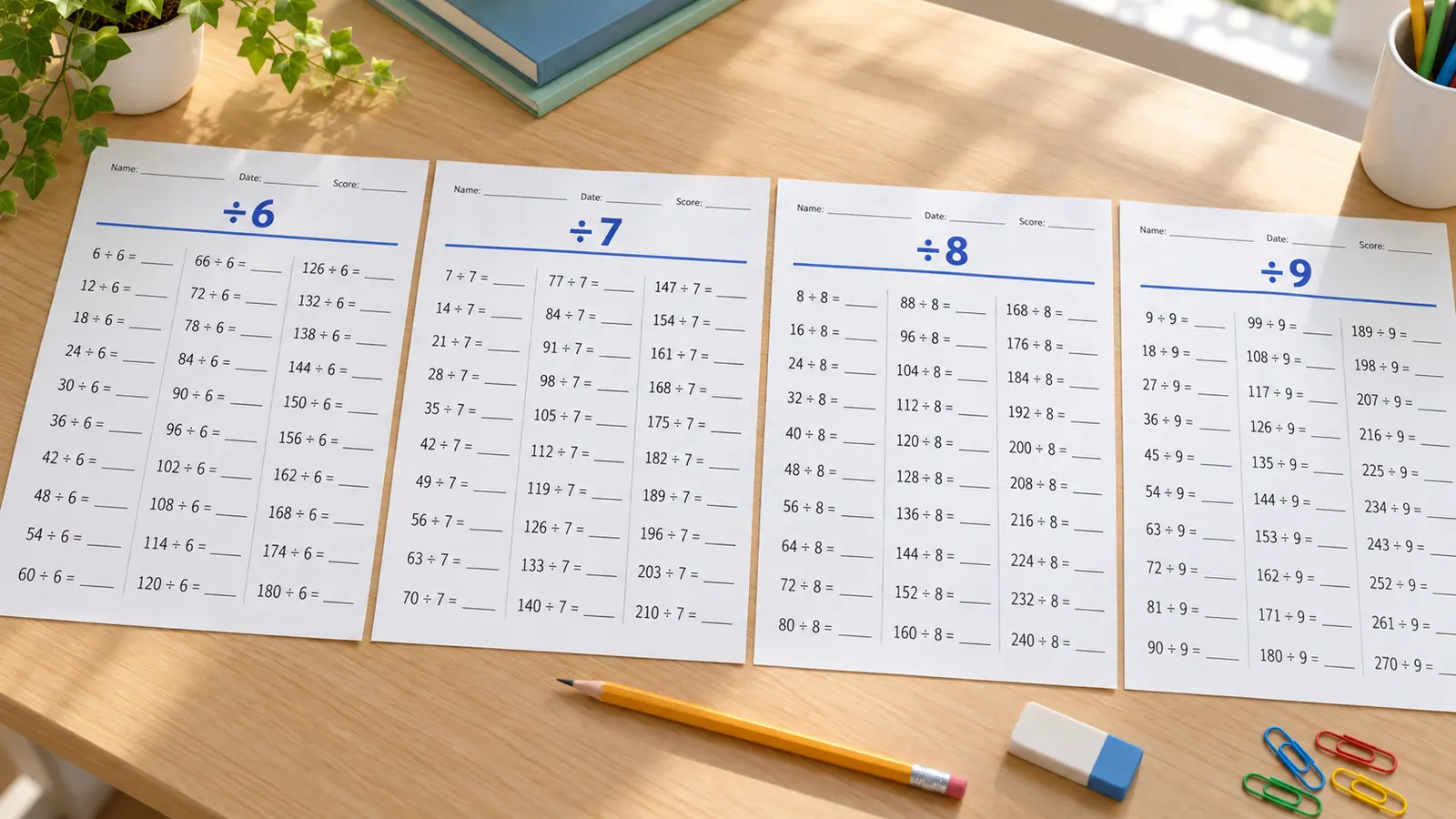
Practise one divisor at a time
Children rarely struggle with every divisor. Dividing by 6, 7, 8 and 9 is where the hardest times tables come back, so one preset uses only those divisors with quotients from 2 to 10. Another covers dividing by 2 to 5, and you can type any single divisor you like, for example 7 in both boxes. Each sheet then shows 42 ÷ 7 and 56 ÷ 7 together, and the dividends are the 7 times table.
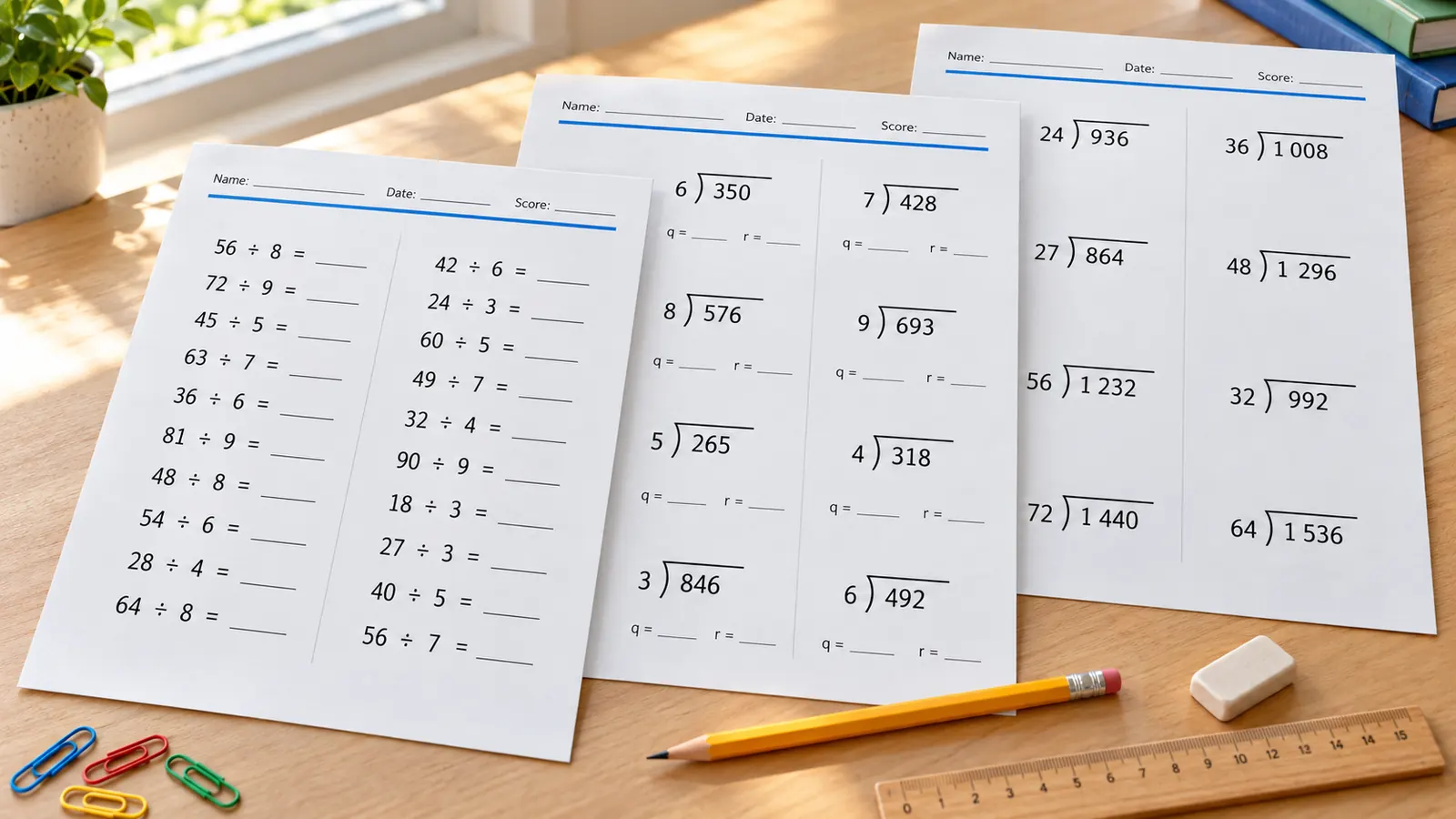
A ladder from division facts to long division
Ten presets follow the order schools teach division: facts to 10 and 12, remainders, 2- and 3-digit numbers divided by one digit with and without remainders, and finally long division by a 2-digit number. Each preset sets the ranges and layout, and you can still change any number, for instance to make 4-digit dividends.
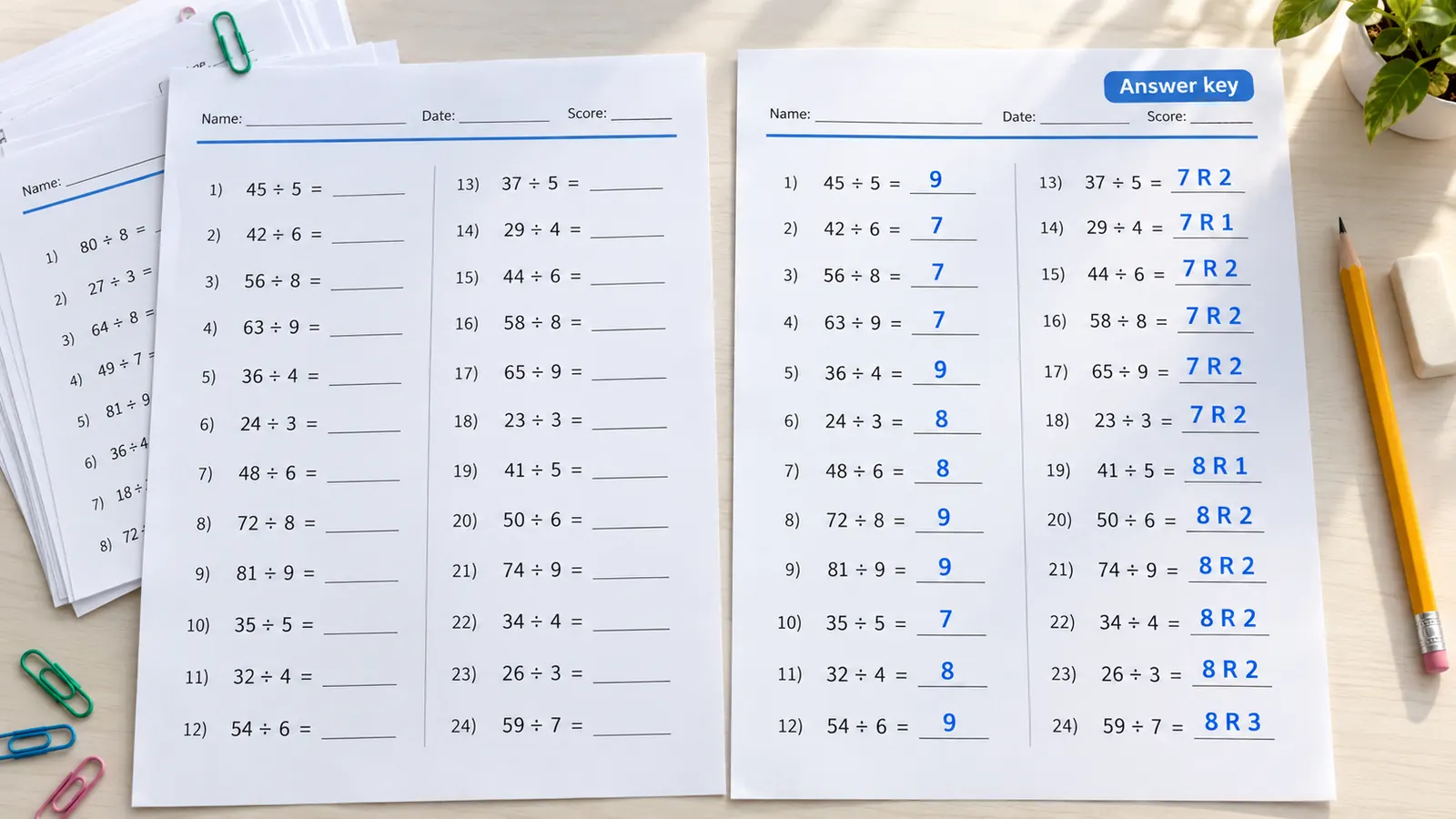
Answer keys and a new sheet every time
Every sheet comes with a key that is calculated from the same problems, with quotients and remainders in blue, placed after each sheet or at the end of the PDF. Make up to 30 different sheets at once for a class, a week of practice or a retake.
What the free division worksheets generator includes
Everything runs in your browser, with nothing to install.
PDF, PNG or print
One PDF with every sheet and key, a PNG for tablets, or print straight from the page. No watermark.
Row or bracket
Facts in a row such as 72 ÷ 8 = ___, or the long division bracket with room to write the quotient and your own working.
Missing number
Fill-in problems such as 56 ÷ ☐ = 7 show that division and multiplication undo each other.
Your division sign
Print ÷ as in the US and UK, or switch to : or / to match your own textbook.
50-problem drills
A ÷ 2 to 12 drill in five columns for beating your own time, with answers to check.
Private by design
Problems are made on your device. No account, no student names stored, nothing uploaded.
How to make division worksheets in four steps
From a blank page to printed sheets with an answer key in about two minutes.
Choose the division level
Open the division presets and pick the step your child or class is on. The US Common Core asks children to divide within 100 fluently by the end of Grade 3 (3.OA.C.7), to find quotients and remainders with up to four-digit dividends and one-digit divisors in Grade 4 (4.NBT.B.6), and to use two-digit divisors in Grade 5 (5.NBT.B.6); the standard algorithm follows in Grade 6. In England, Year 4 recalls division facts up to 12 × 12, Year 5 uses short division with remainders for up to 4 digits by 1 digit, and Year 6 uses long division by a 2-digit number.
- Not sure of the level? Print one sheet and see how many problems your child finishes comfortably.
- Division facts should feel easy, ideally alongside the matching times tables, before you move on to the bracket layout.
Set the quotient and divisor ranges
The first range is the quotient, which is the answer, and the second is the divisor. To practise only ÷ 7, type 7 in From and To of the divisor and keep the quotient at 2 to 10. A single divisor has few different facts, so widen the quotient range or add a second divisor if the warning says problems will repeat. The generator avoids showing a problem twice on a sheet as long as the ranges are wide enough.
- One sheet, one skill: keep the 6 to 9 facts, remainders and long division on separate sheets.
- For 4-digit dividends with a 1-digit divisor, set the quotient from 500 to 999 and the divisor from 2 to 9.
Pick layout, remainders, problems per page and sheets
Use horizontal for division facts and missing numbers, and vertical for the bracket layout. Thirty facts per page suit fluency practice, 12 give short division room to breathe and 8 suit a 2-digit divisor. Switch on Allow remainders when remainders are the lesson, and open the Paper, color and symbols settings to choose ÷, : or / and the long division layout. Choose how many different sheets you need and add the name, date and score line.
- Choose Automatic columns first, then adjust if you want more writing space.
- For a timed drill, use the 50-problem preset and let the child beat their own time.
Print with the answer key
Press Print or download a PDF. Print at 100% (actual size) on US Letter or A4 and choose black and white to save ink. Keep the key for yourself or hand it out for self-checking, and teach children to check a division by multiplying back: for 100 ÷ 7 = 14 R 2, 7 × 14 = 98 and 98 + 2 = 100.
- Check that the print dialog says 100% or actual size, not fit to page.
- Press New problems to make a different version any time.
Division worksheets FAQ
Answers about division facts, remainders, long division, answer keys and printing.
Yes. There is no paid tier, no account and no watermark on the PDF, PNG or print. The problems are generated in your browser, so nothing you enter is uploaded.
Under Number ranges, type 7 in both From and To for the divisor, and keep the quotient at 2 to 10. Every problem is then a fact like 42 ÷ 7 or 63 ÷ 7. The 2 to 5 and 6 to 9 presets do the same for a group of divisors.
Grade 3 (Year 3–4): the division facts presets. Grade 4 (Year 4–5): remainders, then 2- and 3-digit numbers divided by one digit. Grade 5 (Year 6): long division by a 2-digit divisor. In the Common Core, 3.OA.C.7 asks for fluent division within 100 by the end of Grade 3, 4.NBT.B.6 covers up to four-digit dividends and 5.NBT.B.6 two-digit divisors. Schools differ, so treat these as a guide.
Yes. Choose an answer key after each worksheet or all at the end. The key is calculated from the same problems and shows the quotient, and the remainder where there is one, so it always matches the sheet you printed.
Choose a remainders preset or switch on Allow remainders. Each problem is built as divisor × quotient + a remainder between 0 and one less than the divisor, so some problems still divide exactly. The key writes them like 14 R 2. Remainders are always smaller than the divisor.
Choose a vertical preset: 2- and 3-digit numbers divided by one digit, with or without remainders, or a 2-digit divisor. The page draws the bracket and leaves room for the quotient. It does not write the subtraction steps, so your child works them out. Use the layout setting to put the divisor on the left or to write the sum in a row.
In 42 ÷ 6 = 7, the dividend is 42 (the number being shared), the divisor is 6 (the number you divide by) and the quotient is 7 (the answer). If something is left over, that is the remainder. Dividend = divisor × quotient + remainder is the check for any division.
Short division, the bus stop method in England, divides by a 1-digit number and keeps the carries in your head or as small numbers. Long division writes out every subtraction and is used for divisors of two digits or more. England teaches short division in Year 5 and long division in Year 6. The same bracket layout is used for both.
Within one sheet they do not, as long as the ranges are wide enough. Across many sheets they can: division facts 2 to 10 hold only 81 different problems, divide by 2 to 5 and 6 to 9 have 36 each and facts to 12 have 121. The page warns you when a range is small, so widen it for more variety.
Choose the missing number preset, or use the horizontal layout and set the blank to a missing number. Children solve 56 ÷ ☐ = 7 or ☐ ÷ 8 = 7, which uses the times tables. Common Core 3.OA.B.6 calls this understanding division as an unknown-factor problem. Remainders are removed automatically so each blank has one answer.
Make your division worksheets with the free generator now
Choose a level, press print and hand out fresh sheets with matching answer keys in two minutes.
Free, no sign-up, no watermark, and nothing leaves your device.
Tip: print the answer key on colored paper so it never gets mixed up with the worksheets.