Printable Guide
When to Send Save the Dates: A Wedding Timeline
Learn when to send save the dates for local and destination weddings, plan invitations and RSVP deadlines, and copy clear wording for paper or digital cards.
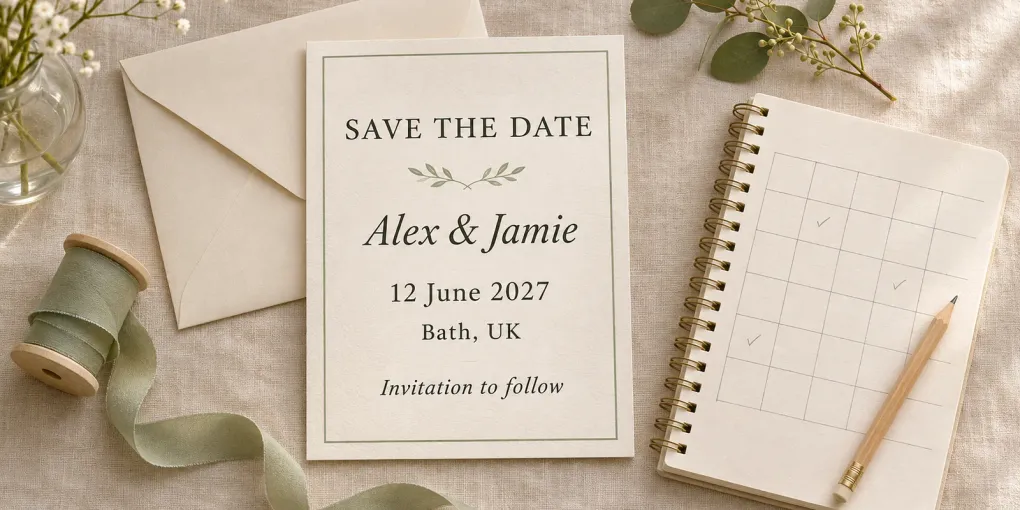
When to send save the dates: aim for about 6–8 months before the wedding as a practical starting point, or 8–12 months ahead when guests need substantial travel planning. Send only after the date, location and recipients are secure. These are planning ranges, not universal etiquette deadlines: a local celebration and an overseas wedding need different notice.
The save the date reserves space in a guest’s calendar; the formal invitation supplies the confirmed event details and asks for a reply. For a conventional US stationery schedule, invitations often go out 6–8 weeks before the wedding. Set the RSVP deadline from your venue’s final headcount date, leaving time to follow up, and thank people promptly as gifts arrive. Use the save-the-date maker for the early card and the wedding invitation maker for the later suite.
Updated 2026-11-02. Timing advice below distinguishes source recommendations from our suggested planning examples.
When to send save the dates: choose your planning window
There is no single agreed month. Zola’s timing guide recommends 4–6 months for a local wedding and 8–12 for a destination wedding. Minted’s stationery checklist uses 6–8 months, with earlier notice for international travel. That variation is a reason to consider your guests, not a reason to delay while searching for one correct number.
| Your situation | Suggested save-the-date window | What determines the choice |
|---|---|---|
| Most guests live nearby | Around 6 months; 6–8 offers extra room | Work schedules, childcare and other commitments |
| Many guests need flights or several nights away | 8–12 months | Time off, travel budgets and accommodation |
| Holiday weekend or a busy local event | Use the earlier end of your travel window | Competing plans and lodging availability |
| Wedding booked less than 4 months away | Tell confirmed invitees promptly | Send one clear invitation if full details are ready |
| Date more than a year away | Personal heads-up first if helpful | Avoid a printed promise before bookings are secure |
The table is our planning framework, not a claim that every country follows it. A wedding in your hometown can still be a destination trip for half your guests. Equally, a venue abroad does not mean every guest needs the same notice if most already live there.
Before you choose a month, list the people who need the longest preparation: someone requesting annual leave, a family arranging school schedules, or a relative coordinating assistance for travel. Ask what information they need early. Give confirmed facts without asking them to buy nonrefundable travel before the plan is reliable.
When to send save the dates after booking the venue
A calendar window is useful only if you can stand behind the information. Before sharing a card, confirm these five things:
- The full date and year. Check the booking and your own calendar together.
- The location. City and country may be enough for an early card; the street address can follow.
- Who you can host. Capacity and budget must support every recipient.
- Which event they are invited to. A reception-only guest should receive wording that clearly names the reception.
- A reliable contact. Verify the postal address, email or messaging account.
Treat an early card as a commitment to send that person an invitation. Do not use it to test whether a provisional guest is interested before deciding whether there is room. Finalize children and named partners wherever possible; a message addressed to a whole family can create expectations you did not intend.
You do not need the menu, flowers, dress code or final ceremony time to announce a confirmed date. Delay for a missing essential, not for unfinished decoration decisions. If a professional photo will arrive too late, use an existing suitable photograph or a simple personal message first.
Keep one record per household for delivery and separate names for attendance. Useful columns are recipient names, delivery method, address checked, early card sent, invitation sent, response, and follow-up needed. That prevents one couple receiving duplicate mail while another household gets missed.
When to send save the dates for destination and holiday weddings
For travel-heavy events, the important question is when guests must make decisions. Minted’s save-the-date guidance suggests 9–12 months for destination weddings. Use the longer lead time when it helps guests arrange leave, accommodation and a realistic budget.
Share the confirmed city and country, the wedding date, and any additional event dates that the particular recipient is invited to attend. A Saturday ceremony with an optional Friday gathering is different from a required three-day stay. Label optional events clearly and avoid implying that everybody must attend every activity.
A holiday date may need early notice even if the ceremony is local. For a US Thanksgiving weekend or a UK bank holiday weekend, check the actual year’s calendar and local accommodation situation before telling guests to book. Do not assume a holiday falls on the same numbered date each year.
If accommodation is not ready, say so: “Hotel suggestions will follow; please contact us before booking if you need help.” When a room block becomes available, share its actual booking cutoff and conditions separately. A hotel cutoff is not automatically the wedding RSVP deadline, and a tentative travel conversation is not a final attendance confirmation.
For guests abroad, spell out the month and include the year: 12 June 2027 or June 12, 2027, rather than 06/12/27. Send important updates directly to affected people; a quiet website edit may not reach someone who already saved an old card.
Build the invitation and RSVP schedule backward
Ask your venue or caterer for its final numbers deadline before printing a reply date. Also ask whether dietary requirements, meal selections, seating arrangements or transport numbers have separate deadlines. Use the earliest relevant requirement.
Our suggested working formula is:
Guest reply deadline = supplier’s final numbers deadline minus a follow-up buffer.
A buffer of 7–14 days is a practical planning choice, not an industry guarantee. Extend it if guests reply by international post or you have complicated seating and meal assignments. If your venue needs numbers unusually early, move the invitation date earlier too so guests have a reasonable response period.
Emily Post’s wedding planning checklist recommends mailing invitations 6–8 weeks before the wedding. Minted’s invitation guidance advises earlier mailing for destination weddings and when no advance card was sent. These are useful English-language references; family expectations and local practice can differ.
| Item | Its job | Information it needs |
|---|---|---|
| Save the date | Help guests reserve time | Names, wedding date, city, invitation-to-follow line |
| Formal invitation | Invite named people to a defined event | Date, start time, venue/address, reply method and deadline |
| RSVP request | Collect usable attendance decisions | Guest names, attendance and only the extra details you need |
| Follow-up message | Resolve missing or unclear answers | A direct question and a specific response date |
| Thank-you note | Personally acknowledge a gift or help | What you are thanking the recipient for |
Put a real reply method on the invitation: a monitored email address, phone number or a response service you have arranged. The PrintMigo editor creates stationery files; it does not run an online RSVP form or collect guest responses. The invitation wording guide helps you separate the main card from practical details.
When to send save the dates: a worked calendar
Here is an illustrative plan for a wedding on 12 June 2027, with a fictional venue requiring final numbers on 29 May. Replace that supplier date before copying the schedule.
| Task | Example date | Reason |
|---|---|---|
| Travel-heavy guest list: send early cards | June–October 2026 | About 8–12 months of notice |
| Mostly local guest list: send early cards | October–December 2026 | About 6–8 months of notice |
| Check addresses and finish invitation proof | March 2027 | Leave room for corrections and production |
| Mail formal invitations | 17 April 2027 | Eight weeks before the wedding |
| Guest RSVP deadline | 15 May 2027 | Four weeks before the wedding |
| Follow up on unanswered invitations | From 16 May | Resolve missing names, meals and attendance |
| Give final numbers to the venue | 29 May 2027 | The assumed contractual deadline |
| Wedding | 12 June 2027 | Keep a final guest list accessible |
| Send personal thanks | As gifts arrive; continue after the wedding | Avoid building a large backlog |
If you are reading this in November 2026, the earlier travel window in this example has already passed. Send the confirmed date now rather than waiting for an ideal month that is no longer available. If the wedding is only weeks away, send complete information directly and follow up with the people who need to travel.
Separate design day, posting day and arrival day in your calendar. Ordering printed stationery on your intended mailing date leaves no time for production, proof corrections, addressing or delivery. Get actual lead times from your printer and postal service; none are guaranteed by this example.
Write a short card, then choose paper or digital delivery
Use these fictional examples as starting points. Replace every name, date and location, and add a website only if it exists and contains useful information.
Simple card
Save the date for the wedding of Alex and Jamie. 12 June 2027 · Bath, UK. Formal invitation to follow.
Travel-focused message
We’d love you to join us in Bath for our wedding on 12 June 2027. We’re sharing the date early so you can plan travel. Ceremony details and accommodation suggestions will follow with the invitation.
Reception-only message
Please save the evening of 12 June 2027 for our wedding reception in Bath. A reception invitation with the time and venue details will follow.
Short-notice invitation
We’re getting married on 12 June 2027 and would love you to join us. Please see the attached invitation for the ceremony details and reply by 15 May using the contact shown. We understand that the shorter notice may make attendance difficult.
For paper, make one proof before producing the batch. In the save-the-date editor, choose a photo layout and 5 × 7 inch, 4 × 6 inch or A6 card, replace the sample details and inspect the crop. Export the PDF on A4 or US Letter to match your printer. Print at 100% or Actual Size, trim a sample and test the envelope. Use cardstock supported by your printer; the cardstock guide explains the checks.
For digital delivery, export a single-card PNG and attach it in your own messaging or email app. Open it on a phone before sending. Include the names, date and location as plain text in the message too, so recipients can search, copy or read them with assistive technology. Downloading or sending an image does not confirm delivery, attendance or an RSVP.
Choose the method the recipient actually uses. A direct call followed by a mailed card can suit someone who rarely checks email; a personal message may reach a traveling friend faster. The delivery format changes production time, but guests still need time to plan.
Send thank-you notes while details are fresh
Keep a gift record from the first present: giver, item or contribution, date received, personal detail and note sent. Acknowledge early gifts early rather than holding all the notes until after the wedding.
Emily Post’s wedding thank-you guidance recommends writing within three months of receiving a gift, preferably much sooner. This is US etiquette guidance, not a universal deadline for every culture. A practical personal target is a few notes each week as gifts arrive, continuing promptly after the celebration.
Use a specific sentence: “Thank you for the beautiful serving bowl. We’re looking forward to using it when our families visit.” For money, thank the giver for the generous gift and, if you wish, mention a genuine plan without listing an amount. A late personal thank-you is still worth sending.
The wedding invitation maker includes a matching thank-you card layout. You can print the design and add a personal handwritten message; a decorative printed heading alone does not replace that acknowledgement.
Frequently asked questions
Is a year too early?
Not necessarily for international travel or a busy destination, provided the date, location and invitation list are secure. For a nearby celebration with flexible guests, there may be little benefit in sending a formal card that far ahead. Consider a personal heads-up followed by the card nearer your chosen window.
Are three months too late?
It is later than the usual planning ranges, but useful notice is better than silence. Send confirmed details now. If the full invitation is ready and its mailing date is close, combine the information in that invitation instead of sending two nearly identical messages.
Do we need a save the date at all?
It is optional. For a small local celebration where everyone already knows the date, a timely invitation may be enough. An early message is particularly useful when guests need leave, travel or accommodation, regardless of whether you buy printed cards.
Does receiving one mean a guest must be invited?
Plan on it. Recipients may request leave or spend money based on your message. Settle capacity before sending. If serious circumstances change your plans, contact affected people personally rather than silently leaving them off the later invitation list.
Should guests RSVP to the early card?
Usually the formal attendance request comes with the invitation. You can ask for an early indication to help with travel planning, but label it as provisional and explain when a final reply will be needed. Keep “received the card” separate from “will attend” in your records.
What if the date changes?
Contact everyone who received the original announcement promptly. State the old date, the new confirmed date or that a replacement date is pending, and what guests should do next. Update the wedding website if you have one, then send corrected stationery. Do not rely on changing an image that guests may already have downloaded.
Once you know when to send save the dates, put the actual send date and your supplier’s deadline in the same calendar. Create your early announcement, proofread it with another person, and prepare the formal invitation suite when the event and reply details are ready.