Printable Guide
Wedding Invitation Wording: Examples for Every Host
Copy wedding invitation wording for parents or couples hosting, formal or casual celebrations, plus clear RSVP, address, dress code and adults-only notes.
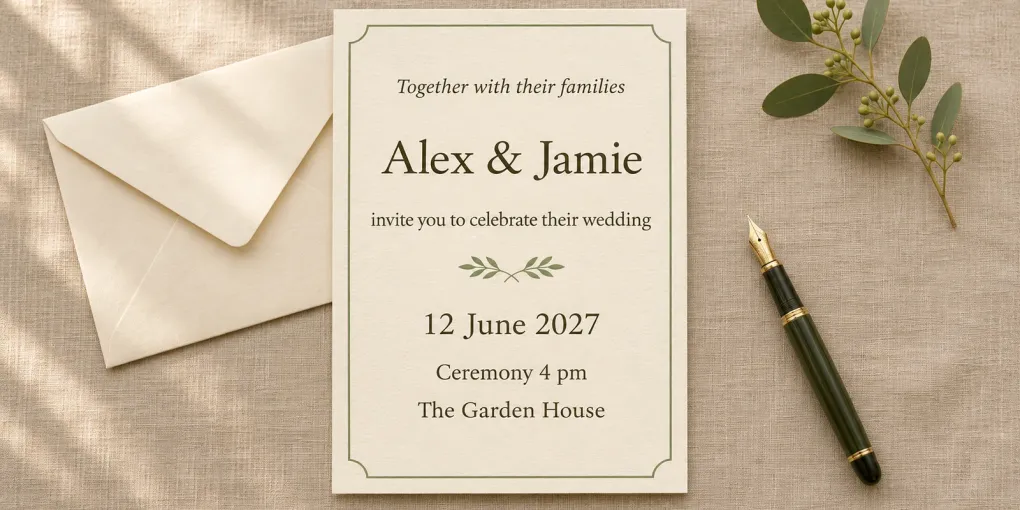
Good wedding invitation wording tells guests who is getting married, what they are invited to, when to arrive, where to go and how to reply. Start with this simple version: “[Name] and [Name] invite you to celebrate their wedding on [written date] at [time], [venue and address]. [Reception information]. Please reply by [date] using [reply method].” Add a host line if you want to name parents or acknowledge family.
Choose the example below that matches your celebration, replace every bracketed detail, then check it against your venue booking and guest list. Keep travel, dress guidance and longer explanations on a details card. The PrintMigo wedding invitation maker provides coordinated invitation, details and reply layouts for putting the finished text on paper.
Updated 2026-11-02. Examples are original, editable starting points. Etiquette references describe traditions, not rules every couple must follow.
What wedding invitation wording needs to include
Treat the invitation as a set of instructions before treating it as a keepsake. A guest should be able to answer these questions without calling you.
| Guest’s question | Information to include | Useful wording or check |
|---|---|---|
| Who is inviting me? | Couple’s names; optional host names | Use the names each person wants printed |
| What am I invited to? | Ceremony, reception or both | “Wedding ceremony and dinner” is explicit |
| When should I arrive? | Full date, year and event time | Distinguish arrival from ceremony start |
| Where do I go? | Venue, street address and city | Add room name or entrance if needed |
| Is there another location? | Reception venue and start time | Give the second address separately |
| How do I answer? | Reply deadline and contact or card | State one preferred response method |
| Who else is invited? | Named guests or clear party allowance | Match the envelope to the reply instructions |
Emily Post’s invitation overview identifies hosts, event, location, timing and reply information as the basic content even when the language is informal. The practical additions above help guests act on that information.
Write the month in words for guests from different countries: June 12, 2027 and 12 June 2027 are both unambiguous. “06/12/27” is not. Check the weekday separately; copying an attractive example can accidentally leave last year’s Saturday attached to this year’s date.
Choose wedding invitation wording for your hosts
The host line expresses how you want to present the invitation. Discuss it with the people being named instead of trying to turn it into a public breakdown of who paid for what.
| Your situation | Suggested opening | What to decide together |
|---|---|---|
| Couple inviting guests directly | “[Name] and [Name] invite you…” | Name order and full names or everyday names |
| Family acknowledged collectively | “With their families…” | Whether everyone is comfortable with the phrase |
| One parent or household hosting | “[Host names] invite you to the wedding of…” | Preferred names and relationship wording |
| Both families named | List the hosts, then “invite you to celebrate…” | A readable order approved by those named |
| Separated or blended families | Put each host on a separate line | Avoid implying relationships that do not exist |
| A deceased parent remembered | Add a remembrance line, if wanted | Keep remembrance distinct from issuing the invitation |
You can omit relationship labels altogether. “The wedding of Maya Chen and Alex Rivera” works without deciding whether to print “daughter,” “son,” “bride” or “groom.” For a same-sex couple, the same structure works; agree on name order and keep it consistent across the suite.
For complicated families, a short collective opening may be kinder and clearer than squeezing six host names into a tiny space. If named hosts matter to you, move practical details to an insert rather than reducing the whole invitation to difficult-to-read type.
Formal wedding invitation wording you can adapt
A formal tone can still be straightforward. These examples leave addresses as placeholders so nobody accidentally prints a fictional venue address.
Parents issuing the invitation
[Host one] and [Host two]
invite you to share in the wedding celebration of
[Partner one]
and
[Partner two]

Saturday, the twelfth of June
two thousand twenty-seven
at four o'clock in the afternoon

[Venue]
[Street address]
[City, state or region]

Dinner and dancing at the same venue
If both families are hosting, list both sets of names above the invitation line. If only one parent is hosting, use that person’s chosen name. Read the full sentence aloud: the host names should connect naturally to the invitation and the couple’s names.
Couple inviting guests with family acknowledgment
With their families
Maya Chen and Alex Rivera
invite you to share their wedding day

Saturday, 12 June 2027
Ceremony at 4:00 p.m.
[Venue and complete address]

Celebration dinner follows at 6:00 p.m.
Please see the enclosed reply card
For a traditional religious invitation, Emily Post distinguishes “the honour of your presence” for a house of worship from “the pleasure of your company” for other venues. Those are optional conventions; the source’s formal wording guidance is useful when that style is important to your family. Modern plain language does not need to imitate every convention.
Keep time styling consistent: use words throughout a very formal version, or a clearly written date and numerical time throughout a modern one. The goal is a coherent, readable card.
Casual wedding invitation wording and reception-only examples
Relaxed wedding, including a same-sex couple
Sam Brooks and Leo Martin
are getting married!

Join us for vows, dinner and a night of dancing
on Saturday, 12 June 2027

Please arrive at 3:30 p.m.
Our ceremony begins at 4:00 p.m.
[Venue and complete address]

Reply by [date] to [contact]
Choose one warm sentence that sounds like you. A long love story can go on your website or in a separate note. Practical information should remain easy to scan, even on a playful design.
Reception after a private ceremony
We are celebrating our marriage
and would love you to join us.

Maya Chen and Alex Rivera
invite you to a wedding reception
on Saturday, 12 June 2027 at 6:00 p.m.
[Reception venue and complete address]

Dinner, toasts and dancing
Please reply by [date] using [method]
If you have already married, change the opening to “We are married!” If an evening invitation does not include dinner, describe the actual event, such as “Drinks and dancing from 8:00 p.m.” Guests should not need to infer whether they should eat beforehand.
For separate ceremony and reception guest lists, export separate invitation versions. Do not print the ceremony time on a reception-only card. UK stationery examples often distinguish evening guests explicitly; Your Wedding Invitation’s wording samples illustrate that distinction. Apply it to your actual event rather than assuming every wedding has the same schedule.
Address, dress code and children: clear details-card notes
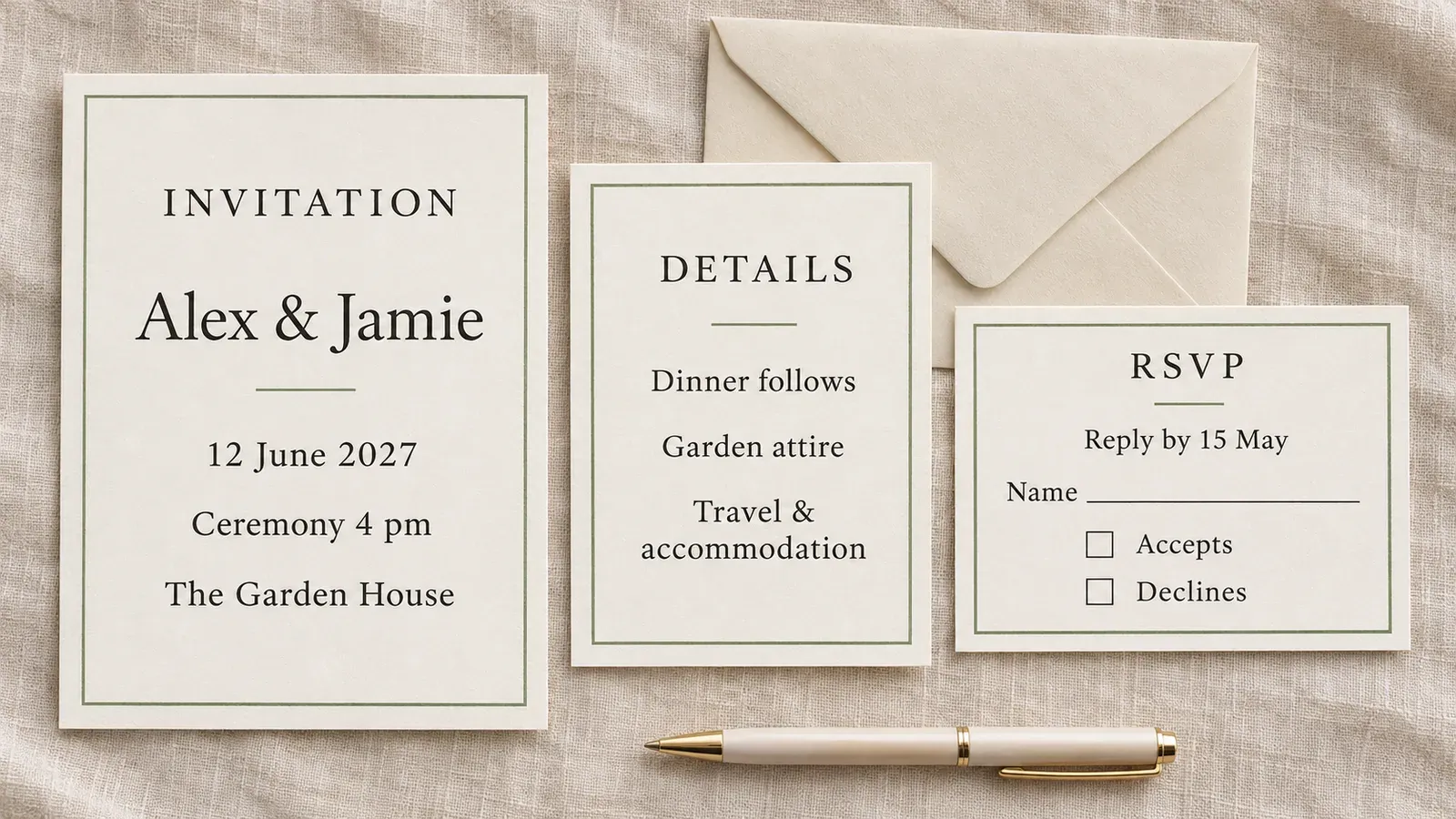
Illustrative stationery arrangement; the printed designs are not screenshots of the editor.
Give each piece a job. The main invitation contains the event essentials. The details card handles navigation, travel and guest expectations. The reply card asks for the information you need back. A single card is also fine when all the information fits comfortably.
| Detail | Copyable wording | Check before using |
|---|---|---|
| Arrival and entrance | “Please arrive from 3:30 p.m. and use the garden entrance. The ceremony starts at 4:00 p.m.” | Entrance is available at that time |
| Separate reception | “Dinner begins at 6:00 p.m. at [venue, address].” | Travel time between locations is realistic |
| Outdoor dress guidance | “Dress: smart casual. The ceremony is on grass; choose shoes you can walk in comfortably.” | Fits the actual surface and celebration |
| Formal dress guidance | “Dress: black tie optional.” | Everyone planning the event uses the same expectation |
| Adults-only event | “Our ceremony and reception are for guests aged 18 and over.” | The age threshold and any exceptions are settled |
| Children welcome | “Children named on your invitation are warmly welcome.” | Every invited child’s name is included |
| Limited invitations | “Please reply for the guests named on your invitation.” | Named guests match your records |
| Access questions | “For step-free access information, please contact [name/contact].” | That person has checked the actual route |
An adults-only reception does not automatically mean an adults-only ceremony. Specify which events the policy covers. If a few named children are attending, explain the exception privately to affected families and keep all written information consistent. Do not claim the venue prohibits children unless it actually does.
For international guests, add the country to the venue address and specify the local time zone if they will join a livestream. Check any map link yourself. A beautiful venue name alone may lead to the wrong property or entrance.
Reply wording, meals and the save-the-date difference
A useful reply request has a date, a destination and a clear action. For example:
Please return this card by [day month year]
Guest name: ______________________
□ Attending   □ Unable to attend
Meal choice: _____________________
Dietary requirements to discuss: _____________________
Return to: [name and full address]
Set the deadline by working backward from your caterer’s final-count date, leaving time to contact missing respondents. There is no deadline that suits every venue. Use the same date on paper, on your website and in reminder messages.
The RSVP card maker provides three editable meal labels with printed checkboxes. Where each guest needs a meal choice, use one card per person or another response method that connects every name to a meal. “Two chicken, one vegetarian” is insufficient if the caterer needs to know who receives each plate. Follow up on dietary requirements with the venue instead of treating the notes as confirmed accommodation.
PrintMigo creates downloadable cards; it does not collect responses or total meals. If you prefer replies by email, replace the return instruction with “Please email [contact] by [date] with each guest’s name, attendance and meal choice.” Test that contact before sending.
A save the date is an earlier announcement, usually much shorter:
Save our date
Maya and Alex
12 June 2027 · [City, country]
Full invitation to follow
Use the save-the-date maker for that announcement, including a photo if wanted. Save the detailed arrival times and reply instructions for the invitation once they are confirmed. Send early notices only to people you intend to invite.
Proofread the words before printing the suite
- Check the event against the booking. Confirm date, year, weekday, ceremony time, venue address and reception arrangements.
- Check people against the guest list. Review spellings, chosen names, hosts, invited children and companions.
- Ask a fresh reader to act as a guest. They should identify when to arrive, where to go and how to answer without extra explanation.
- Review every card together. Remove conflicting deadlines, old sample names and duplicated paragraphs.
- Open the exported files. Check line breaks and small text at actual size before printing the batch.
The main PrintMigo invitation is 5 × 7 inches, the matching details card 4 × 6 inches, and the compact reply card 3.5 × 5 inches. These are this tool’s sizes, not universal stationery standards. It exports PDF sheets for A4 or Letter and PNG files; prepare and export each card type separately.
Print one proof at 100% or Actual Size on paper supported by your printer, then check the trimmed card in its envelope. The cardstock printing guide covers paper compatibility. If the wording is cramped, shorten it or move information to the details card before reducing text size.
Frequently asked questions
Can you write a short wedding invitation for us?
Yes: “[Name] and [Name] would love you to join their wedding celebration on [written date] at [time], [venue and address]. [Reception details]. Please reply by [date] to [contact].” Replace every placeholder and name the invited events clearly.
Does wedding invitation wording have to name our parents?
No. Choose a couple-led opening if that reflects your plans. If you want to acknowledge family, use a collective line or name the people involved after agreeing on the wording with them.
Whose name should appear first?
Agree on an order that suits you and use it consistently. There is no need to assign a “bride’s position” or “groom’s position” to a couple whose names or relationships do not fit that convention.
Where should the wedding website go?
Put the address on the details card or a short line near the reply instructions. Include a readable address even if you also use a QR code, and make sure guests can find the promised information there.
Should the invitation mention gifts?
For a traditional approach, keep gift requests off the invitation. Emily Post’s invitation dos and don’ts advises against including registry information. You can answer questions separately without making a gift sound like a condition of attendance.
Can we include two languages?
Yes. Make sure both versions convey the same event, time, address and reply deadline. Have a fluent reader check each one; if both texts become too small, prepare separate language versions or use an additional insert.
Once your wedding invitation wording is complete, open the wedding invitation maker, choose a coordinated style and enter the approved text. Download one complete sample and read it as a guest before preparing the rest.