Potty Training Chart Printable sticker chart with your child's name, picture steps and small rewards
Pick 10 to 50 sticker spots, add the sit–pee–flush–wash picture steps, choose animals, dinosaurs or princesses and set a reward for spot 5 or 10. Print on US Letter or A4. Free, no sign-up, and nothing leaves your browser.
10–50 sticker spots · picture steps · 3 picture themes · stage rewards · PDF, PNG and print
How it worksMake your potty training chart: type the name, pick a theme, print
The chart opens with 10 sticker spots, four picture steps and a story at spot 5. Change the name, the number of spots, the theme and the rewards, then check the preview before you print.
Quick templatesPick a sticker grid, weekly reward chart, behavior chart, chore chart, potty training chart, classroom chart or monthly chart.
Prize picture (last spot)
Picture theme
Chart layout
Number of stickers
Paper size
Orientation
Print styleRainbow
Printable reward chart preview
US Letter · Portrait · Rainbow
Potty training chart: quick facts
Short answers for parents and childcare staff comparing free ways to print a chart.
- Price
- Free, with no paid tier or download fee
- Account
- Not required
- Watermark
- None
- Export formats
- PDF, PNG and direct print
- Paper sizes
- US Letter and A4
- Supported sizes
- 10, 12, 15, 20, 25, 30, 40 or 50 numbered sticker spots; portrait or landscape; the last spot is always the prize
- Privacy
- Runs in your browser; nothing you type is uploaded
- Languages
- 8 languages: English, Chinese, Spanish, Portuguese, French, German, Japanese, Korean
- Picture steps
- Up to 6 steps with a number and a small picture each: sit on the potty, pee or poo, flush, wash hands, dry hands, tell a grown-up
- Themes
- Animals, dinosaurs, princesses or none, in 8 colour schemes, plus ink-saver and black and white
- Stage rewards
- A small reward at any spot, for example “5: extra story”; the gift icon and the words print on that spot
- Spots
- Empty circles for real stickers, or choose a star, sticker face or check mark guide
- Last updated
- October 18, 2026
Best for
- Parents starting potty training who want a simple chart with their child's name on it
- Childcare and preschool staff who print one chart per child
- Families who want small rewards on the way and a big one at the end
Not the best fit for
- Night-time dryness: a day chart does not track nights, which usually come later
- Replacing readiness: a chart helps once a child shows interest and can stay dry for a couple of hours, it does not make a child ready
- Printing the stickers themselves: you stick real stickers on the spots, or draw a star
How it compares
- Fixed PDF charts (Pampers, Printabulls, Bravery and Belonging)
- Quick to download and nicely drawn, for example Pampers' four charts or Bravery and Belonging's dinosaur and princess paths. The designs are fixed, so you cannot change the number of spots or the child's name, and the Pampers page shows a rewards sign-up box. Here you set both, and nothing needs an account.
- Email-gated chart packs (Ready to Potty)
- A good set of charts with advice, but the download asks for your email address first. Here there is no email step.
- Other online chart makers (PottyWhiz)
- PottyWhiz also lets you set a name, a theme and the number of stars. Here you also get picture steps, stage rewards that print on the chart, and a choice of Letter or A4.
- Canva and Etsy editable templates
- Total design freedom, but you edit every box yourself and some templates are paid. Here the chart is built for you; the price is less design freedom.
Why this potty training chart is quick to make and easy to use
Three things a fixed PDF cannot do.
A potty training chart in your child's favourite theme
Type your child's name, choose 10 to 50 sticker spots and pick animals, dinosaurs or princesses. The little pictures appear in the header and the corner of every spot, and eight colour schemes let you match a bathroom wall or a favourite colour.
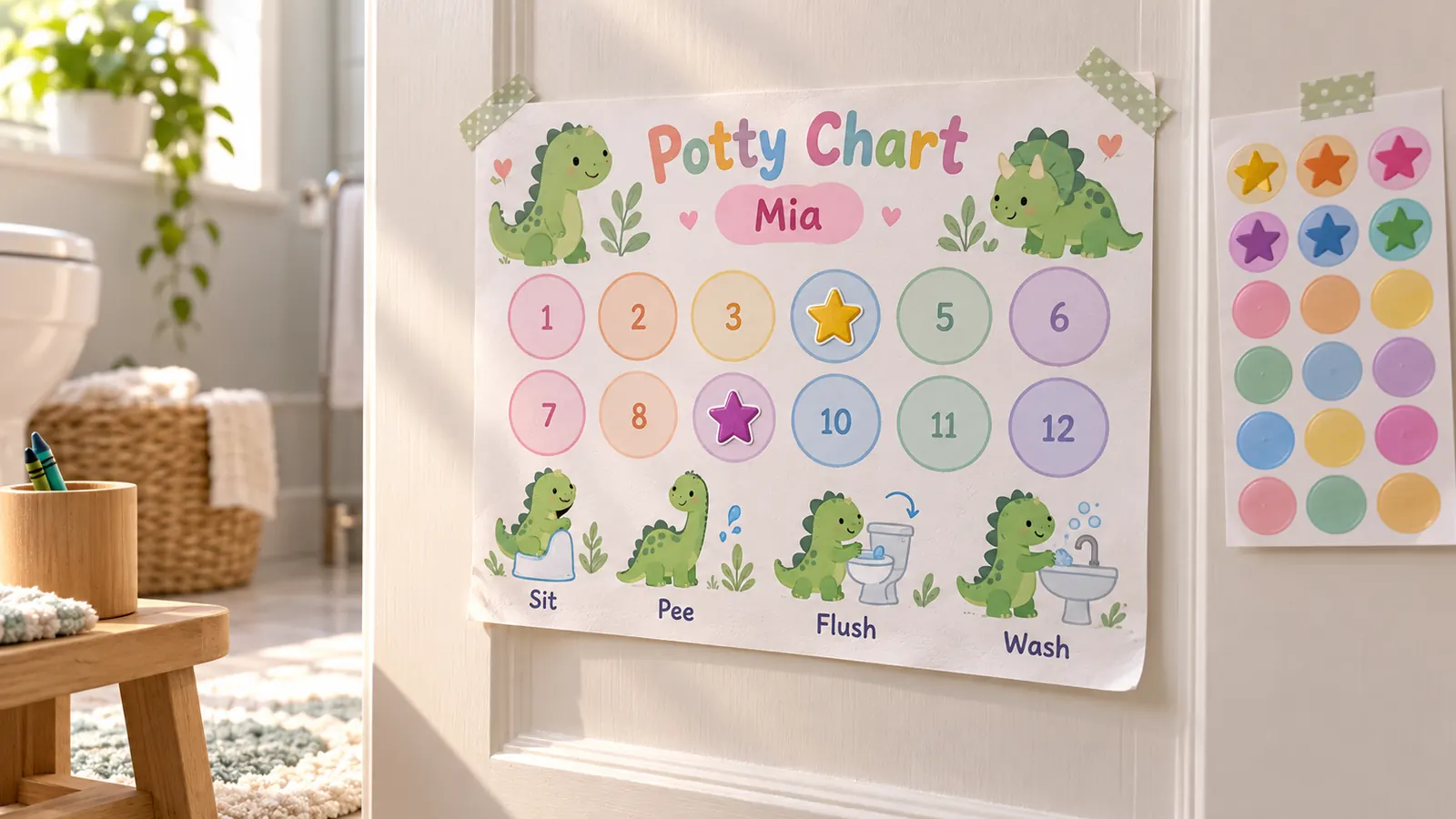
Picture steps for sit, pee, flush and wash
A row of numbered pictures shows the order at a glance: sit on the potty, pee or poo, flush, wash hands. Young children cannot read yet, so they can point to the picture. Edit the words, or turn the steps off for a plain sticker chart.
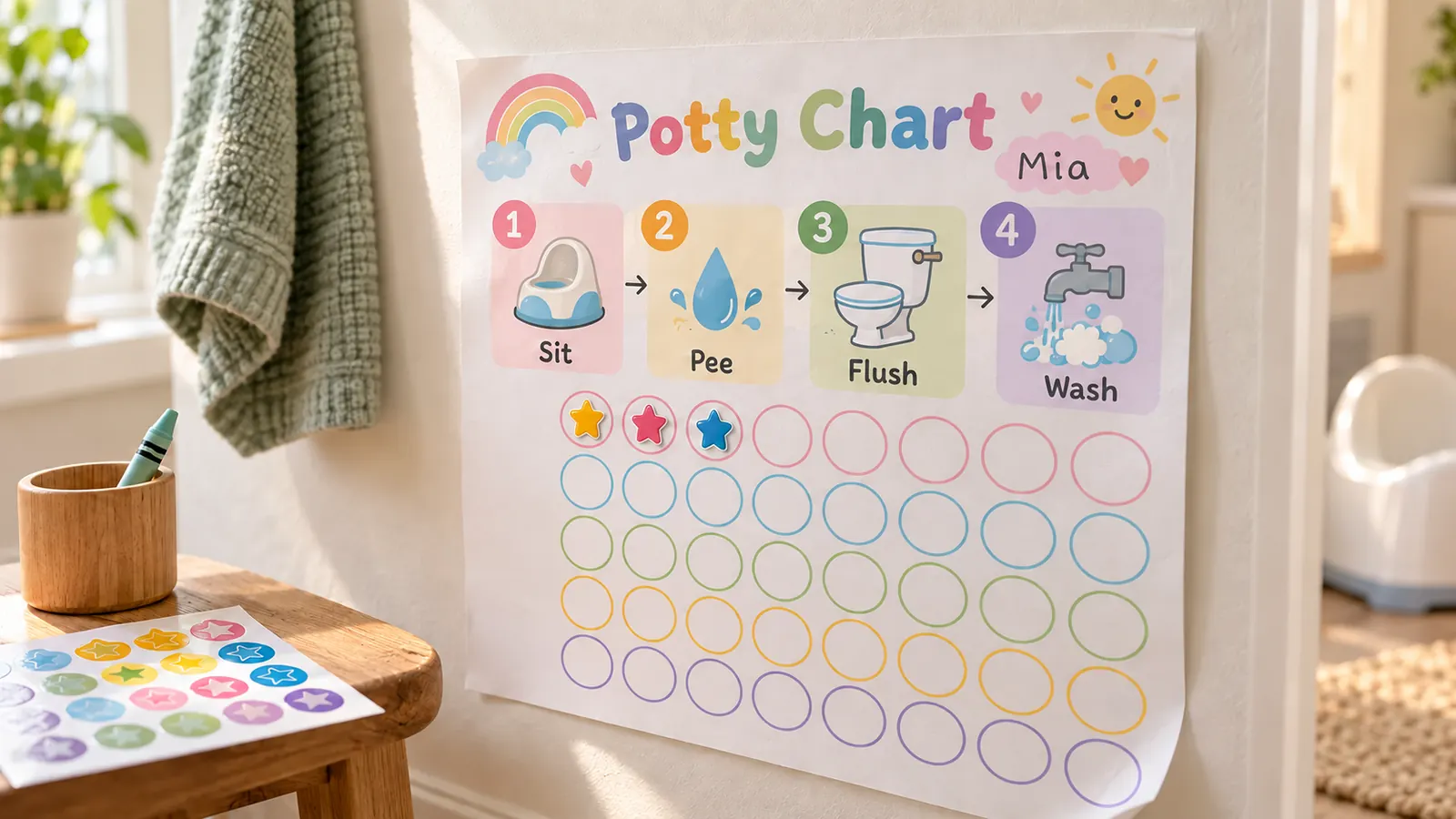
Stage rewards on the way, a prize at the end
Put a small reward on spot 5, 10 or 15, such as an extra story or a trip to the park, and a bigger one on the last spot. The gift icon and the words print on that spot. Print on US Letter or A4 and keep the chart at child height.
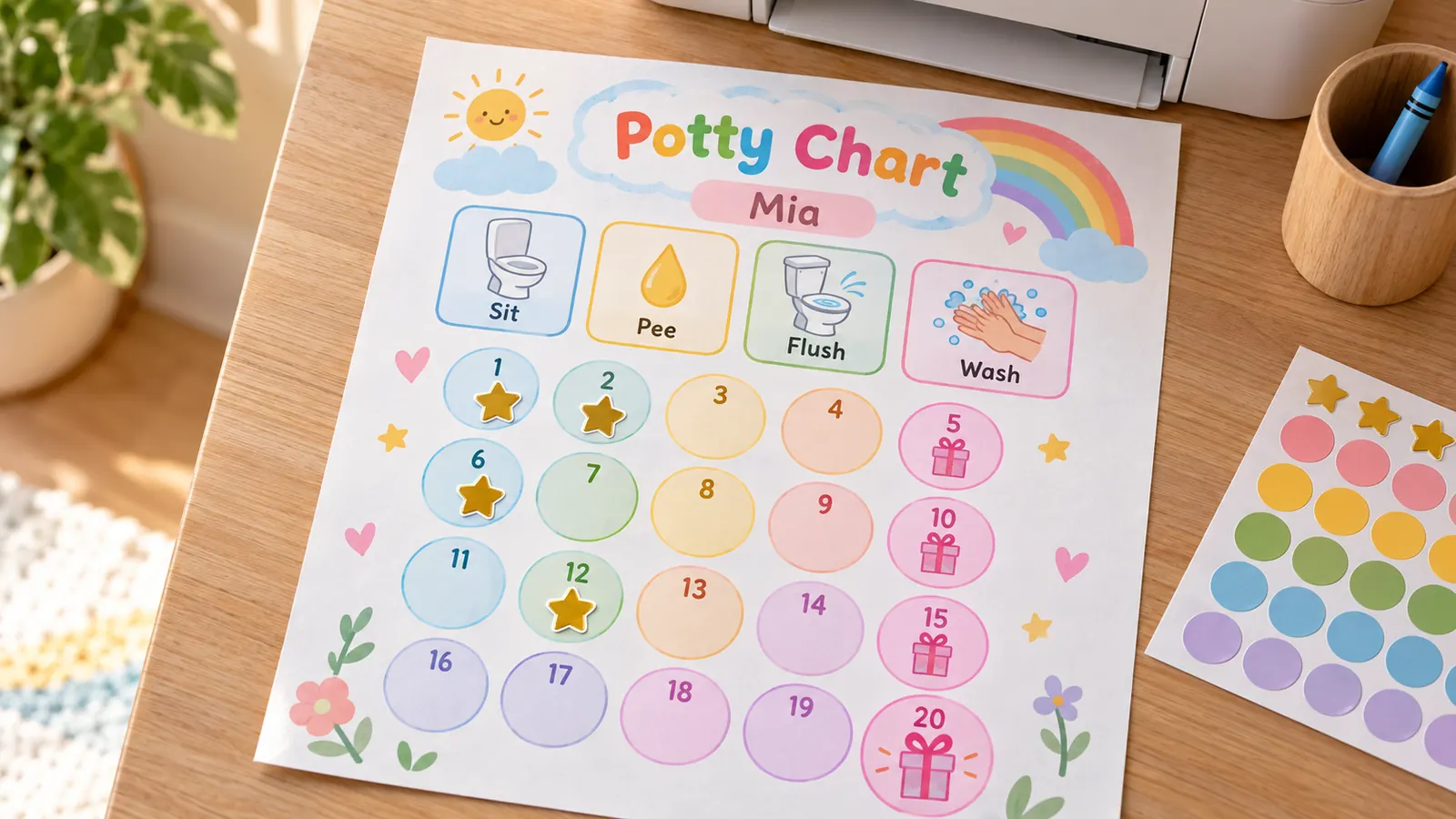
What this potty training chart includes
Everything runs in your browser; nothing to install, nothing to upload.
PDF, PNG or print
One PDF, a PNG, or print straight from the page. Same as the preview, no watermark.
10 to 50 sticker spots
Numbered spots with a prize on the last one. Start small and print a longer chart later.
Picture steps
Sit, pee or poo, flush, wash hands: a numbered picture for every step, with words you can edit.
Animals, dinosaurs, princesses
Three picture themes in eight colour schemes, plus an ink-saver and a black and white option.
Letter and A4
Portrait or landscape on US Letter or A4, so it fits any home printer.
Private by design
No account, no ads, no upload. Your child's name stays on your device.
How to use a potty training chart: set it up in four steps
From a blank page to a chart on the bathroom wall in a few minutes.
Wait for readiness, then pick the chart
The American Academy of Pediatrics says toilet training usually starts between 2 and 3 years in the United States, and the CDC says most children are not able to toilet train until 2 to 3 years old. Look for signs such as staying dry for a couple of hours and following simple instructions. Then choose a theme and the number of spots; 10 is a good first chart.
- Starting too early can cause stress and setbacks, according to the CDC, so wait if your child shows no interest.
- A move, a new baby or a family crisis is a good reason to wait, says the AAP.
Set the steps and the rewards
Keep the three or four lines that say when a child earns a sticker, such as trying to use the potty or washing hands. Turn on the picture steps so the order is clear, and type a small reward for spot 5 and a bigger one for the last spot. Rewards work best when they are small and quick, and Pampers advises against food.
- Reward the try as well as the result, so a child who sits but does not go still gets a sticker.
- Stage rewards such as an extra story or a trip to the park cost nothing.
Print at actual size and hang it low
Choose US Letter or A4 and portrait or landscape. Print at 100% or actual size and turn off fit to page. Use plain paper, or heavier paper if stickers will go on every spot. Hang the chart in the bathroom or a hallway at your child's eye level, with a sheet of stickers and a pencil beside it.
- Low ink mode keeps the colours light for a long chart.
- Laminate or use clear tape if the chart will be handled a lot.
Use it every day and keep it positive
Give the sticker straight away, say what went well and let your child put it on the spot. When the last spot is full, give the prize and decide together whether to start a new chart or stop. If it causes stress, put it away and try again in a few weeks. The AAP advises avoiding punishments, and the NHS says the same about accidents.
- Do not take stickers away for accidents.
- Keep it to the day; night-time dryness usually comes later.
Potty training chart FAQ
Answers about free printing, when to start, how many stickers to use, rewards and keeping a chart positive.
Yes. It is free, needs no account or email and adds no watermark to the PDF, PNG or printout. It is made in your browser, so your child's name is not uploaded.
Hang it at your child's height, give a sticker straight after each try or success and let your child stick it on the next numbered spot. When the last spot is full, give the prize. Keep it positive and put it away if it causes stress.
There is no single age. The AAP says toilet training usually starts between 2 and 3 years in the United States and most children are trained by 4. The CDC says starting too early can cause stress and setbacks. Look for signs such as staying dry for 2 hours and following simple instructions.
They can help some children as a way to see progress and get praise, but they are not a must. The AAP puts praise and mastery first and says to avoid treats and punishments, so use it as a tracker and keep rewards small. If a child ignores it, stop using it.
No authority gives a number. Common charts have 10 spots, and many parents add a small reward halfway. Start with 10 and a reward at spot 5; longer charts of 20 or 30 suit a child who is already doing well. You can print any number from 10 to 50.
Small and quick rewards work best: praise, a hug, a sticker, an extra story, a trip to the park, bubbles or a crayon. Pampers advises against big or expensive prizes and against food. Type your own on the stage rewards line.
Yes. Choose animals, dinosaurs or princesses, and one of eight colour schemes. The pictures appear in the header and the corner of every spot. For a character you love, draw it on the chart or stick a character sticker on each spot.
Yes. Choose US Letter (8.5 × 11 in) or A4 (210 × 297 mm), in portrait or landscape. Print at 100% or actual size and turn off fit to page so the spots keep their size.
Accidents are normal. The AAP advises avoiding punishments and the NHS says not to get angry, so do not take stickers away. If your child resists or regresses, take a break, stay calm and try again in a few weeks.
Make your potty training chart with the free maker
Type a name, pick a theme and the sticker spots, add the picture steps and a reward, and print it in minutes.
Free, no sign-up, no watermark, and nothing leaves your device.
Tip: put the stickers in a small pot next to the chart so your child can choose one.