Printable Guide
How to Make a Wedding Seating Chart: 7 Steps + Sizes
How to make a wedding seating chart in 7 steps: guests per table, who sits where, divorced parents and kids, plus poster sizes (18×24, 24×36, A2, A1).
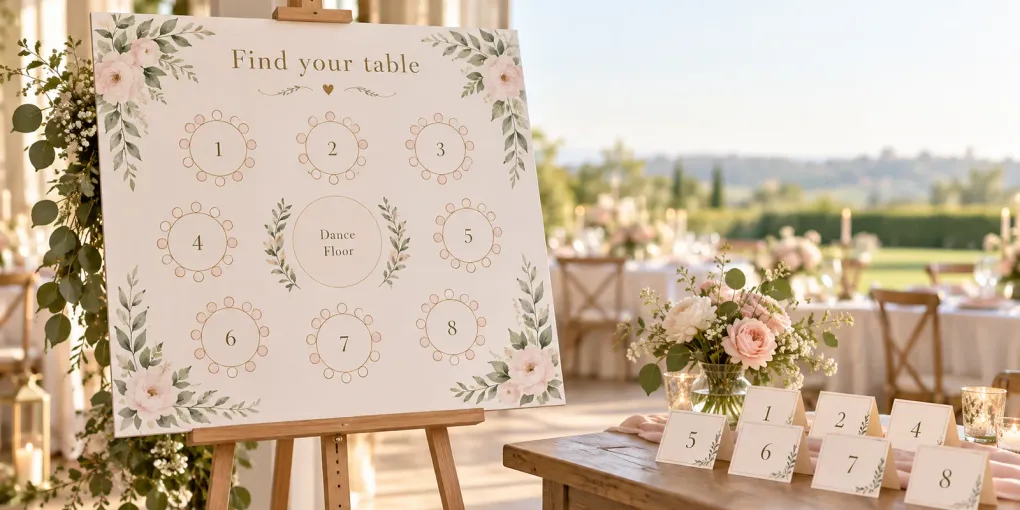
Short answer: to make a wedding seating chart, wait until most RSVPs are in, decide how many guests each table holds (8 at a 60-inch round, 10 at a 72-inch round), seat the couple first, then parents and close family, then the remaining guests in friend and family groups, fix any awkward pairings, and print the result as a poster. For most weddings that means an 18×24 in or 24×36 in sign (A2 or A1 in the UK) listing guests alphabetically with a table number beside each name.
The part guides rarely spell out is the order of decisions and the print size. This article covers how to make a wedding seating chart in seven steps, what to do with divorced parents, exes, kids and plus-ones, how to choose between a chart and escort cards, and which poster size fits your guest count. Updated 2026-10-27.
How to make a wedding seating chart: the 7 steps at a glance
| Step | What to do | Done when |
|---|---|---|
| 1 | Decide whether you need assigned seating | You know if it is tables, seats or open seating |
| 2 | Wait for RSVPs, then build the final guest list | Every plus-one has their own row |
| 3 | Set table sizes and count | Seats per table match what the venue provides |
| 4 | Seat the couple, parents and VIPs | The anchor tables are placed |
| 5 | Group everyone else by relationship | No one is stranded among strangers |
| 6 | Fix the awkward pairings and get a second opinion | Someone who knows the families has checked it |
| 7 | Choose the display and print size | The file is with the printer 2–3 weeks out |
Details for each step follow. If you want to skip to the tool, the free wedding seating chart maker takes a guest list in and gives you the poster and name lists out.
Do you need a wedding seating chart?
No rule requires one. Planning guides generally recommend assigned seating for medium and large sit-down receptions, and say a casual or cocktail-style event can do without (Bridebook). There are three common approaches:
| Approach | Best for | Trade-off |
|---|---|---|
| Open seating | Small, casual weddings (planners quote roughly 60–75 guests or fewer, a rule of thumb rather than a standard) | Couples and families may be split up; late guests get leftover chairs |
| Assigned tables, free choice of chair | Roughly 80–200 guests (Paperlust) | Guests choose their seat, so the caterer still needs meal choices handled another way |
| Assigned seats | Formal sit-down dinners and plated meals | The most work: every seat needs a name |
For most couples hosting a plated dinner, assigning tables gives 90% of the benefit for far less stress than assigning chairs.
When to start and when to finalise
Start after your RSVP deadline, not before. Seating changes with every reply, so a draft built early gets rebuilt. Published advice on the final lock-in varies: from one to two weeks before the wedding (Zola) to three to four weeks (Bridebook, Joy). One longer timeline puts the RSVP deadline 6–8 weeks out and final names with the printer 2–3 weeks out (Paperlust).
The practical rule: work backwards from your printer’s deadline. Ask the print shop how long it needs, add a few days of buffer, and set your final-draft date from that. Chase any missing RSVPs with a phone call, because a chart with “maybe” names gets reprinted.
How to make a wedding seating chart: table sizes and how many tables
Venues give you the table size; you choose how full to make each one. Vendor guides agree that a 60-inch round seats 8 comfortably and a 72-inch round seats 10, with a couple more possible when it is tight (SeatPlanning, Blossom Furnishings).
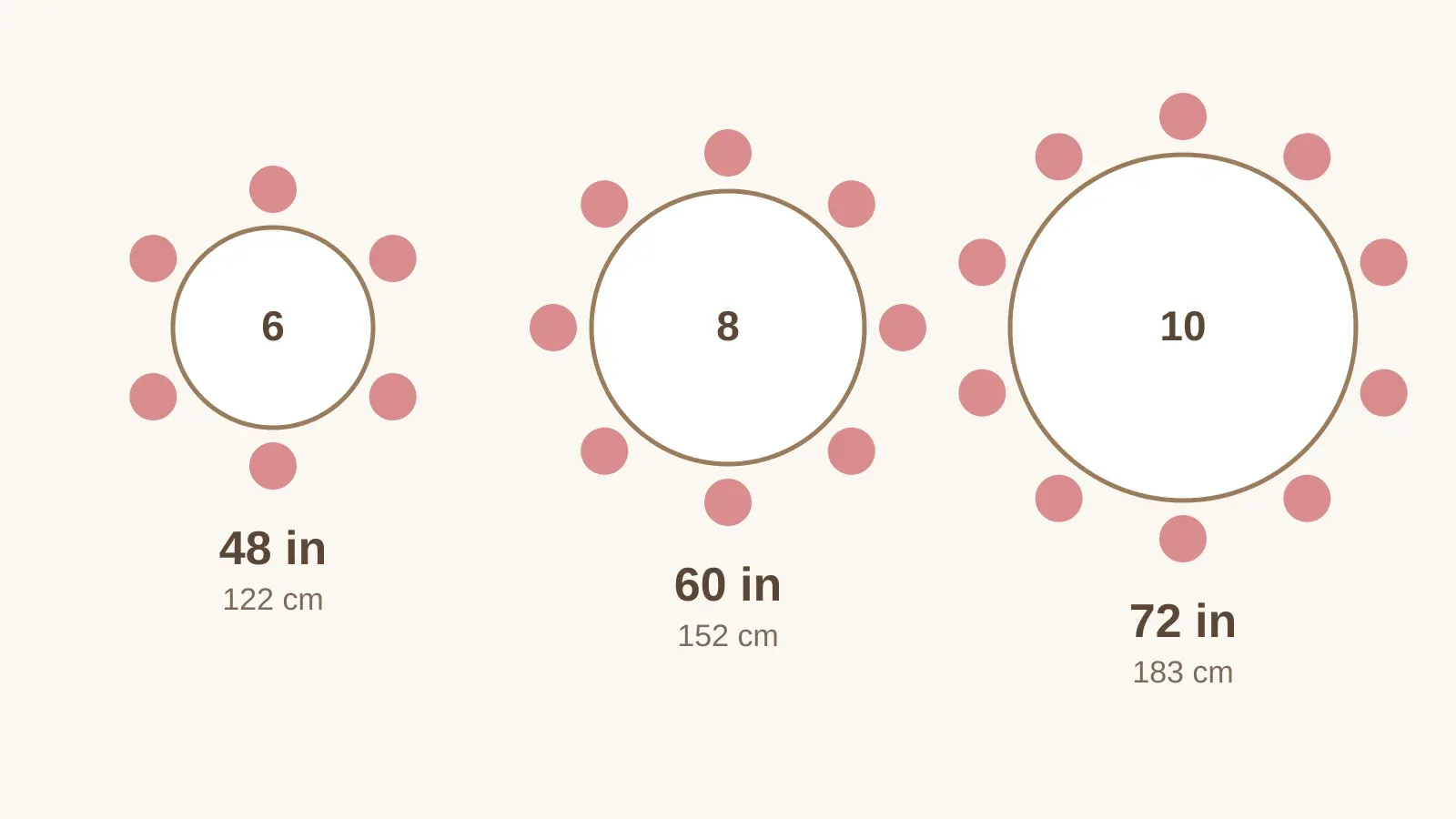
| Table | Comfortable | Maximum |
|---|---|---|
| 48 in round | 6 | 8 |
| 60 in round | 8 | 10 |
| 72 in round | 10 | 12 |
| 8 ft banquet (rectangular) | 10 | 12 |
Check your venue’s own numbers and fire-code capacity before you commit, because venue marketing and vendors differ by a seat or two.
How many tables? Divide the guest count by seats per table and round up. For 100 guests that is 10 tables of 10 on 72-inch rounds, or 13 tables of 8 on 60-inch rounds. Plan to fill tables to about 90% so late changes still fit (Paperlust). In a seating-chart tool, set the table count and seats per table first, so the chart matches the room.
How to make a wedding seating chart: seat the couple first
Most guides agree on one order: couple, then parents and grandparents, then the wedding party, then close family, then friends and everyone else (Zola, Bridebook UK). Anchor tables first makes the rest easier.
- Place the couple’s table: a head table, a two-person sweetheart table or a regular round table (next section).
- Anchor the family tables nearest the couple. Ask parents where they would like to sit instead of guessing.
- Group the rest by relationship: college friends, work colleagues, cousins, neighbours. Put one outgoing person at each table.
- Mix lightly. Splitting one large friend group over two adjacent tables beats a table of twelve.
- Think about the room. Seat older guests away from speakers and the dance floor, and nearer exits and restrooms.
- Avoid a “singles table.” Four independent sources warn against it; seat single guests among people they already know.
How to make a wedding seating chart that survives contact with real families: save one or two flexible seats for the guest who decides at the last minute.
How to make a wedding seating chart: head, sweetheart or top table
| Option | Who sits there | When it works |
|---|---|---|
| Head table | Couple in the middle with the wedding party along the sides | Large wedding, formal photos, clear focal point |
| Sweetheart table | The couple only; the wedding party takes nearby tables | Couples who want a quiet moment and a simple layout |
| Regular round table | Couple plus the wedding party | Smaller, relaxed weddings; no raised table |
| UK top table | Traditional line-up, facing the room | Weddings following British custom |
The traditional UK top table runs, left to right: chief bridesmaid, groom’s father, bride’s mother, groom, bride, bride’s father, groom’s mother, best man (Bridebook UK). Many modern families adapt it, especially with divorced parents, so treat it as a starting point.
How to make a wedding seating chart when families are complicated
Awkward situations are why couples put off the chart. Published etiquette guidance gives these defaults; ask the people involved before you finalise:
| Situation | Common approach | Notes |
|---|---|---|
| Divorced parents | Ask each parent, then seat them at separate tables of equal prominence, each with their own partner and close family, equally near the couple | Share a table or the head table only if they get along (Zola, Paperlust) |
| Step-parents | Sit with the parent they are married to | At a UK top table, a nearby table for the step-parent’s family is the usual alternative |
| Exes | Keep tables apart and use neutral friends as anchors | One stationery publisher advises two tables of distance; there is no formal etiquette rule, so use judgement |
| Young children | With their parents by default | A kids’ table suits many or older children, with a supervising teen and parental consent |
| Plus-ones | Next to their partner, with that partner’s friends | Give each plus-one their own row in your list |
| Vendors | Ask each one; many eat at their station | Practical advice rather than etiquette; count them in your meal numbers |
When guests are in conflict, the usual advice is distance and a neutral table rather than a confrontation. If you are unsure, put the tricky pairing on your “ask the parents” list instead of guessing.
Alphabetical list or by table?
For most weddings, an alphabetical list with the table number beside each name works best, because guests look for their own name, not a table. Sort by last name. Zola and Bridebook both back this approach, and Paperlust suggests an alphabetical entry sign for roughly 60–150 guests (Paperlust); that range is one publisher’s opinion.
A list grouped by table suits a very small wedding, and it is also the version caterers and venue coordinators find handiest. The best chart often has both: the A–Z sign at the entrance and a by-table sheet for staff. The PrintMigo tool prints both from the same plan.
Seating chart, escort cards or place cards?
| Item | What it does | Needed? |
|---|---|---|
| Seating chart | One large sign showing all guests and tables | Optional but common |
| Escort cards | Small card per guest naming their table | Alternative to the chart |
| Place cards | Marks an exact seat at the table | Only for assigned seats or meal choices |
Using both an escort-card display and a full chart for the same job is usually redundant (Zola). Pick the chart for speed, escort cards for decoration, and add place cards only if you assign chairs.
How to display a wedding seating chart
Common displays, from simplest to showiest:
- Poster on an easel or foam board. Cheapest and easiest to reprint; foam core is light for indoor easels.
- Framed print or mirror. Reusable and photogenic, but lettering on a mirror takes time and cannot be edited.
- Standalone wood or acrylic board. Looks good in photos; changes mean a reorder.
- Cards hung on twine or ribbon. Works as escort cards at the same time.
Place the display near the reception entrance, in a spot where guests can stand without blocking the door, and light it. A sign read at arm’s length can hold small, dense text; one read from several feet away cannot (4over4). Test-print one page at the final size before you order.
Wedding seating chart size: 18×24, 24×36, A2 or A1
Sellers and printers are consistent by region. In the US, 18×24 in and 24×36 in are the standard sizes. In the UK, A1 landscape is the usual table-plan size, with A2 and A0 also sold; Australian sellers recommend A1 (Wild Bloom Design Studio, Vintage Prints, Sea and Paper).
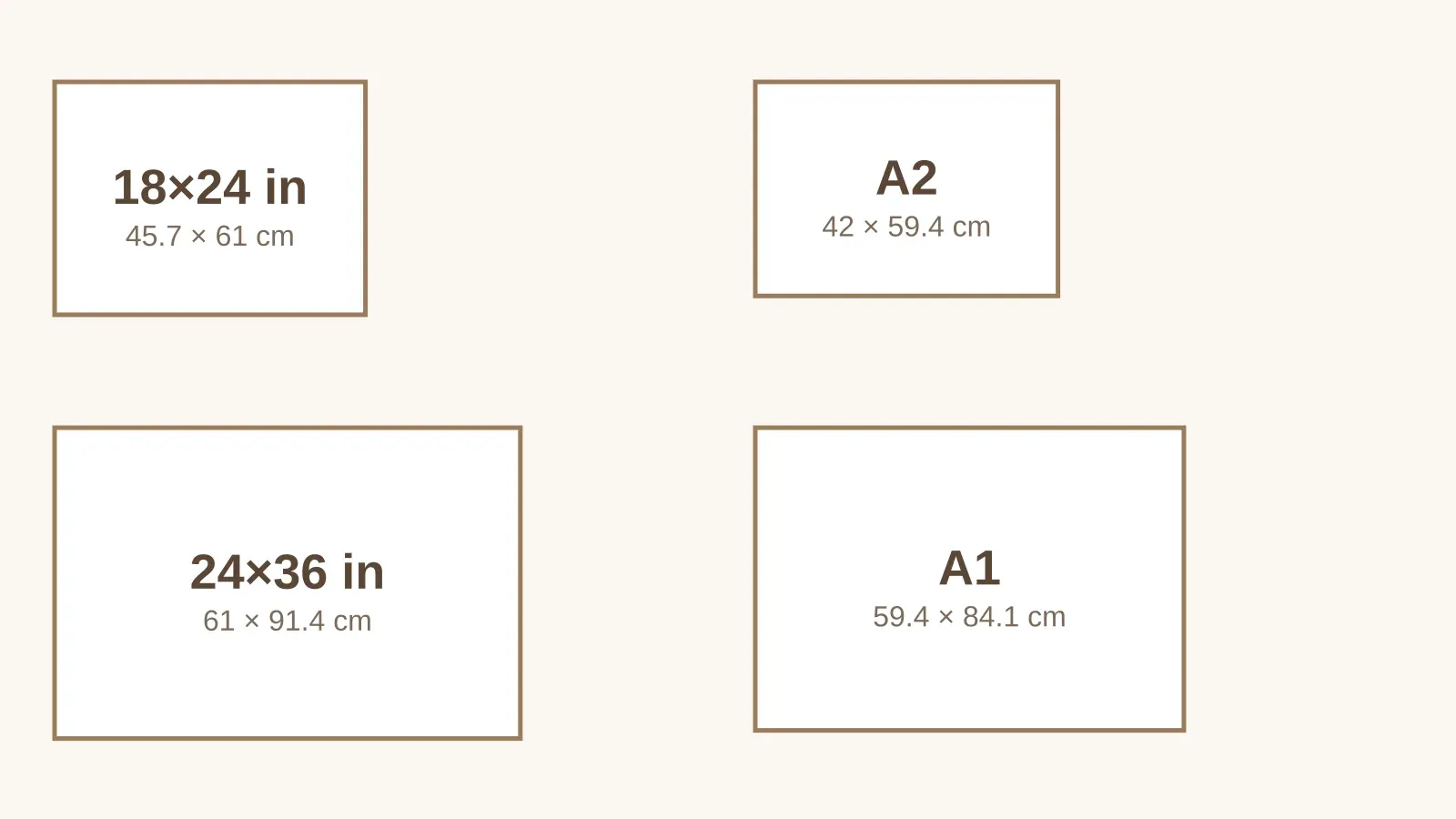
| Size | In cm | Fits | Notes |
|---|---|---|---|
| 18×24 in | 45.7×61 | Up to roughly 100 guests, indoor | Smaller print; one printer pairs it with arm’s-length reading |
| A2 | 42×59.4 | Up to roughly 100 guests | The nearest ISO size to 18×24 |
| 24×36 in | 61×91.4 | Larger lists, readable from a few feet | The common US “large” chart |
| A1 | 59.4×84.1 | Most UK and Australian weddings | The nearest ISO size to 24×36 |
No authority publishes a size-to-guest-count table; these thresholds are an editorial rule of thumb based on seller guidance. If you have more than about 100 names, pick the larger size. Ask the printer for the exact size you chose, plus a proof, and mount it on foam board. Order 3–4 weeks before the wedding if the shop is a UK seller, since lead times vary (Tavern Creative).
How to make a wedding seating chart with PrintMigo
The wedding seating chart maker turns the steps above into a poster. It is free, needs no account, and has no watermark; guest names stay in your browser.
- Add your guests. Paste one name per line or import a CSV. A Table column seats guests straight away. Write names as “Chen, Avery” to sort by last name.
- Set the tables. It opens with eight round tables of eight around a dance floor. You can use 1–12 tables with 1–12 seats each, up to 144 seats on one chart. Try the head-table and sweetheart layouts in the template library.
- Seat and name the tables. Assign in order or at random, then drag anyone who needs a specific seat. Rename tables with numbers or short themes.
- Add the lists. The A–Z find-your-table list and the guests-by-table list are both on by default.
- Pick the size and export. 18×24 in, 24×36 in or A2 as PDF or PNG, plus A4 and US Letter for handouts. The chart is landscape.
It does not track RSVPs, assign seats automatically, or print escort or place cards. For a general version for events and classrooms, see the seating chart maker.
Common mistakes when making a wedding seating chart
- Starting before RSVPs close. You will rebuild it. Draft only as a rough layout.
- Overfilling tables. Plan to about 90% of capacity.
- Forgetting children, vendors and the DJ. Count them in your meal and seat totals.
- A singles table. Guests find it awkward, and planners warn against it.
- Printing before a second pair of eyes. Have someone who knows both families read it first.
- Printing tiny. Check the final size with a test page.
Questions people ask about a wedding seating chart
How do I make a wedding seating chart? Wait for RSVPs, set table sizes, seat the couple and family first, group the rest by relationship, review it with a second person and print a poster. The seven-step table near the top has the full order.
Do you need a wedding seating chart? Not strictly. It helps with a plated or formal dinner and is optional for small casual weddings.
How many guests per table? 8 at a 60-inch round and 10 at a 72-inch round is the usual guidance. Confirm with your venue.
What size should a wedding seating chart be? 18×24 in or 24×36 in in the US; A2 or A1 in the UK and Australia. Use the larger size for longer lists.
Alphabetical or by table? Alphabetical, with table numbers, for most weddings. Add a by-table sheet for staff.
Where do divorced parents sit? At separate tables of equal prominence, each with their own partner and family, equally close to the couple.
When should I finalise it? After RSVPs close; plan from your printer’s deadline, typically 2–4 weeks before the wedding.
What do I ask an AI to help? “Seat 90 guests at tables of 8, keep these families apart and list the A–Z version” works best when you paste the guest list; then check the result against your venue’s table counts.
Make your seating chart now
You now know how to make a wedding seating chart: decide tables or seats, wait for RSVPs, seat the couple and family first, group the rest, check awkward pairings and print the right size. When your list is ready, open the free wedding seating chart maker, import your guests and download the poster PDF for the print shop.