Printable Guide
How to Make Bingo Cards: Words, Card Counts & Odds
How to make bingo cards that work: how many words you need, how many cards to print, real odds and game lengths, and how to call a game. Free printable PDF.
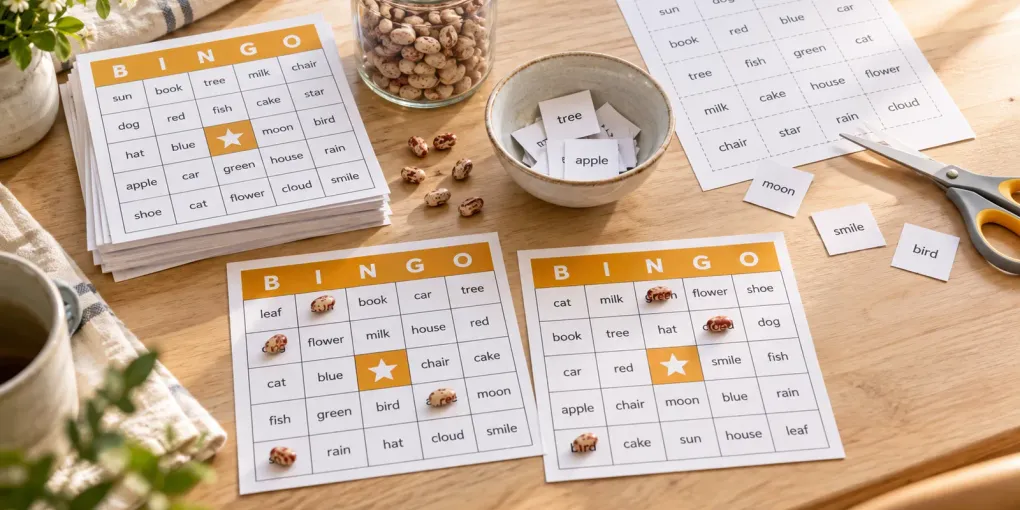
Short answer: to make bingo cards, write a list of at least 24 words or numbers (for a 5×5 card with a free center square), shuffle that list into a different layout for every player, print one card per player plus a few spares, and keep a calling list so you can draw items one by one and check winners. An online generator does the shuffling and layout for you in about a minute; by hand it takes roughly 5–10 minutes per card.
The part most guides skip is what makes the game actually play well: use 30–50 items instead of the minimum 24, decide the winning pattern before you start, and know how long a round will take. This guide covers how to make bingo cards for a party, a classroom or a holiday game, with tables you can use straight away. Updated 2026-10-15.
How to make bingo cards: the quick answer
| Decision | Recommended | Why |
|---|---|---|
| Grid size | 5×5 for teens and adults, 3×3 or 4×4 for kids under 7 | Smaller grids finish faster and are easier to scan |
| Free space | On (center square) | You only need 24 items, and the first line comes sooner |
| Items in your list | 30–50 (minimum 24) | With exactly 24, every card holds the same words |
| Cards to print | One per player + 10% spares | Spares cover late arrivals and spilled drinks |
| Calling method | Calling cards drawn from a bowl | You keep a record of what was called |
| Paper | 160–200 gsm card stock, or regular paper in a sheet protector | Stays flat on the table and survives markers |
What goes on a bingo card: 75-ball, 90-ball and word bingo
Before you make bingo cards, pick the format. There are three common ones:
- 75-ball bingo (US style). A 5×5 grid under the letters B-I-N-G-O. Each column uses a fixed range: B 1–15, I 16–30, N 31–45, G 46–60, O 61–75, and the center square is FREE (Wikipedia: Bingo card). That gives 24 numbers per card.
- 90-ball bingo (UK, Spain, France). A ticket of 3 rows × 9 columns. Each row has 5 numbers and 4 blanks, so a ticket holds 15 numbers. A strip of 6 tickets uses every number from 1 to 90 exactly once. Prizes go to one line, two lines and a full house (Bingo Rental: 90-ball tickets explained).
- Word or picture bingo. Any grid filled with words, phrases or pictures: vocabulary, baby shower gifts, Christmas objects, “find someone who…” icebreakers. This is what most people mean when they search for how to make bingo cards at home.
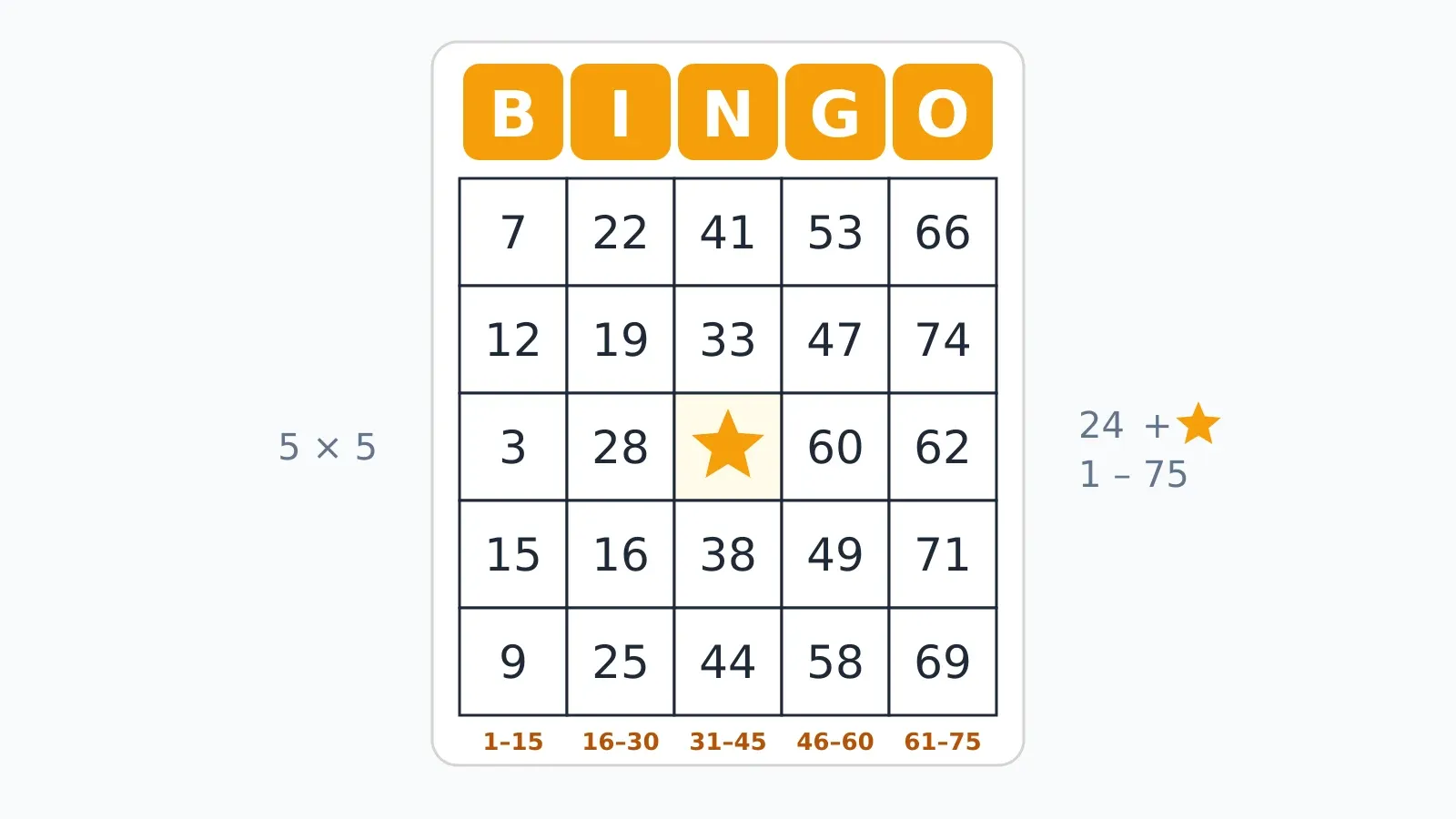
How many distinct 75-ball cards exist? Counting the order of numbers inside each column, there are 552,446,474,061,128,648,601,600,000 possible cards (15·14·13·12·11 for each of B, I, G and O, times 15·14·13·12 for N). If you ignore the order within columns, there are 111,007,923,832,370,565 different sets of numbers. Both figures match the ones Wikipedia cites. The point for you: duplicates are never a problem with numbers. They are a problem with short word lists, as the next sections show.
How to make bingo cards online in 5 steps
The fastest route is a generator that shuffles the list for every card. With the free PrintMigo bingo card generator:
- Add your list. Type or paste one word, phrase or number per line. You can also start from a template (classroom words, sight words, icebreakers, party, baby shower, holiday) or choose number bingo with a 1–75, 1–90 or custom range.
- Pick the grid and free space. 3×3, 4×4 or 5×5. Turn the free space on or off and change its text (FREE, a name, “BABY”, a date).
- Set the card count. Up to 100 cards per batch, and every card gets a different arrangement. The preview shows how many items you have versus how many the grid needs, and warns you if your list is barely above the minimum.
- Choose the page layout. 1, 2 or 4 cards per page, on A4 or US Letter, with a theme (classroom, confetti, garden, ocean, Christmas and more).
- Add calling cards and export. Tick “Add calling cards” to get cut-out slips (24 per page) after the bingo cards, then print or download a PDF or PNG.
Everything is generated in your browser. Your word list is not uploaded, and there’s no account or watermark.
Number bingo has two modes. With Classic B-I-N-G-O columns ticked (5x5, 1–75), each card gets a B-I-N-G-O header and draws B from 1–15, I from 16–30, N from 31–45, G from 46–60 and O from 61–75, and the calling cards read B-7, O-71 and so on. Untick it, or pick the 1–90 or a custom range, and the generator shuffles your range across the whole grid instead. It does not make the 3-row, 9-column 90-ball tickets used in UK-style halls.
How to make bingo cards by hand, in Word or in Google Sheets
You don’t need special software. Here’s how to make bingo cards with what you already have.
By hand (best for 1–10 cards)
- Draw a 5×5 grid on card stock, with squares about 3–4 cm (1.25–1.5 in).
- Write your 24 items on slips, mix them in a bowl and copy them into the grid in the order you draw them. Put them back and re-mix for the next card.
- Mark the center as FREE.
Drawing the slips is what keeps cards random. Copying “from memory” almost always produces near-identical cards.
In Word or Google Docs
Insert a 5×5 table, fix the row height so the squares stay square (about 1.5 in on Letter), set text to center, and type your words. The slow part is rearranging the words for each copy, which is why this method only makes sense for a handful of cards.
In Excel or Google Sheets
Put your list in column A and =RAND() in column B, sort by column B, and the first 24 rows are one card’s worth of words. Re-sort for every card. It works, but you still have to lay each card out for printing.
If you need more than about ten cards, a generator saves an hour or more.
How many words do you need for bingo?
The grid sets the minimum. The game needs more.
| Grid | Items needed (free space on) | Items needed (free space off) | Recommended list |
|---|---|---|---|
| 3×3 | 8 | 9 | 12–20 |
| 4×4 | 15 | 16 | 20–30 |
| 5×5 | 24 | 25 | 30–50 |
Why not just use 24? With exactly 24 words on a 5×5 card, every player has the same 24 words, only in different squares. In a full-card (blackout) game, everyone finishes on the same call. We simulated thousands of games with 25 players to measure how often more than one person wins on the same call:
| Words in list | Typical calls to first line | Line game: shared win | Blackout game: shared win |
|---|---|---|---|
| 24 | 8 | 25% | 100% |
| 30 | 10 | 22% | 53% |
| 40 | 12 | 17% | 39% |
| 50 | 15 | 13% | 30% |
| 75 | 21 | 9% | 17% |
Figures from PrintMigo’s Monte Carlo simulation, random 5×5 cards with a free center, 1,000–2,000 games per row. “Typical” is the median.
Takeaways:
- 30–50 items is the sweet spot for most parties and classes: rounds of 10–15 calls, and far fewer ties.
- Planning a blackout prize? Use 50 or more items, or set a tie rule in advance (split the prize, or play one quick tiebreaker line).
How many bingo cards should you print?
Print one card per player, plus about 10% spares. Then adjust:
| Situation | Cards per player | Notes |
|---|---|---|
| Classroom | 1 | Laminate or use sheet protectors and reuse them all term |
| Kids’ party (under 7) | 1 | 3×3 or picture cards; one card is plenty to manage |
| Adult party or family night | 1–2 | Experienced players enjoy two cards; beginners stick to one |
| Fundraiser or community night | 1 per game played | Print a new set per round if markers are permanent |
| Baby shower gift bingo | 1 | Guests fill in or mark gifts as they’re opened |
Planning several rounds? Instead of printing more cards, use reusable markers (beans, coins, buttons, candy) and clear the cards between rounds. For a Christmas party, the Christmas bingo cards page sets up picture cards with matching calling cards in one click, which works for kids who can’t read yet.
What are the odds of winning bingo, and how long does a game take?
Your odds are simple: if every card is different, each card has about the same chance. Hold 1 card out of 25 in play and your chance is about 1 in 25 (4%). Two cards double it. Ties make the real figure a little fuzzier, but the ratio holds.
How long a round lasts depends on the pattern and on how many cards are in play. More cards means someone hits the pattern sooner:
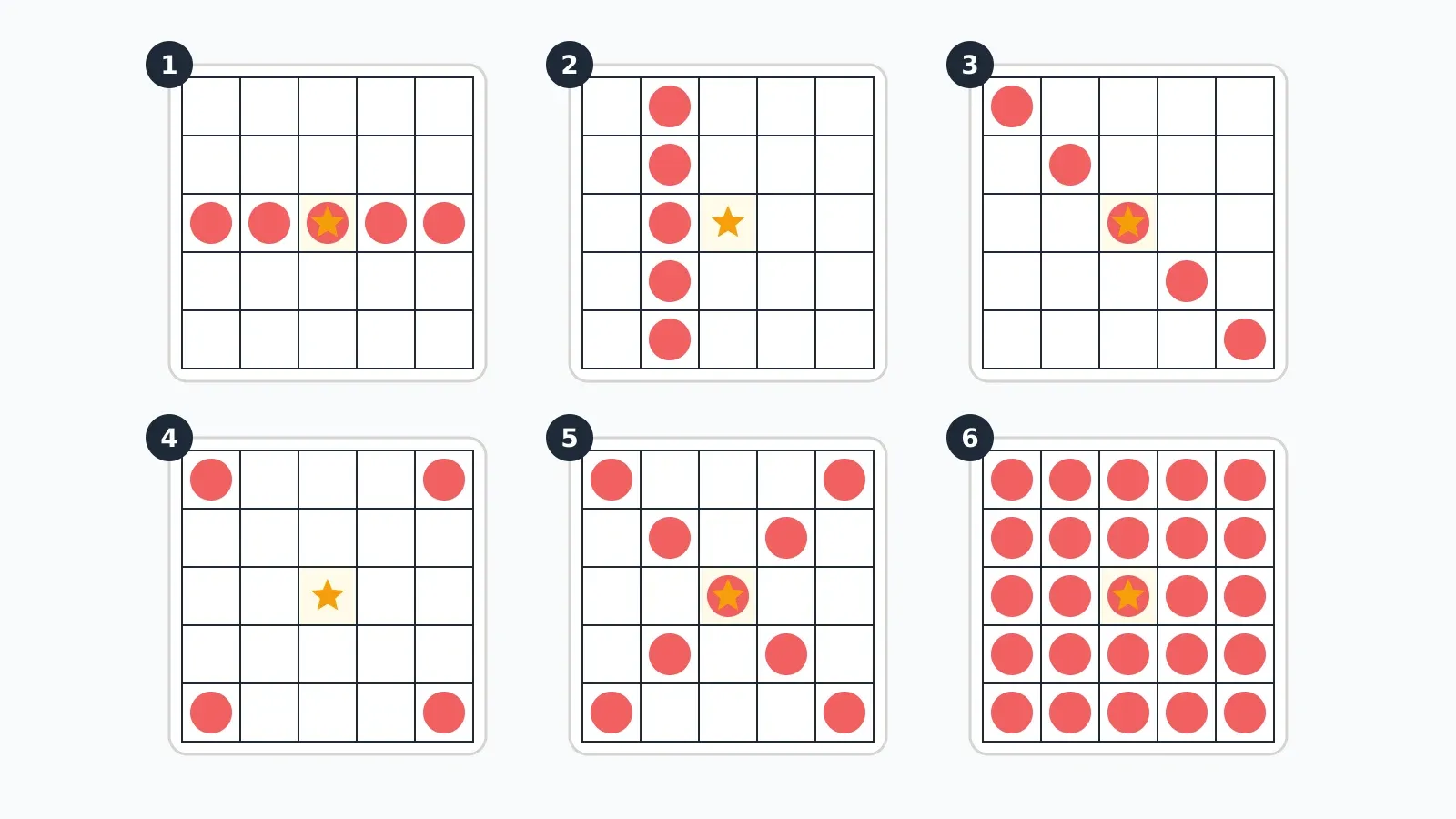
Patterns: 1 row · 2 column · 3 diagonal · 4 four corners · 5 X · 6 blackout (coverall).
| Cards in play | Any line | Four corners | X | Blackout |
|---|---|---|---|---|
| 1 | 42 | 64 | 70 | 74 |
| 10 | 26 | 41 | 55 | 69 |
| 25 | 21 | 33 | 50 | 67 |
| 50 | 19 | 29 | 46 | 65 |
| 100 | 16 | 25 | 43 | 64 |
Median number of calls until the first winner in 75-ball bingo with a free center. PrintMigo simulation, 3,000 games per row.
To turn calls into time, allow about 15 seconds per call (read it twice, let people mark). A line game with 25 players then lasts around 5 minutes and a blackout around 15–17 minutes. Add 1–3 minutes per round for checking the winner and handing out a prize, so an hour of party bingo is roughly 6–8 line games, or 3–4 line games plus one blackout finale.
How to call a bingo game and check winners
- Announce the pattern before each round (“any line, including diagonals” or “four corners”) and say whether the free space counts.
- Draw at random. Use cut-out calling cards from a bowl or hat, a ball cage, or a random number generator. Read each item twice and pause long enough for the slowest player.
- Keep the called items. Put drawn slips in a separate pile or tick them on the calling list. That’s how you check a claim.
- Verify every “Bingo!” Have the player read their marked squares back. Check each against the called pile.
- Settle ties in advance. Say before the first call whether simultaneous winners split the prize or play a tiebreaker.
Tips for kids and classrooms: say the word and show the calling card at the same time. Use pictures for pre-readers, and keep rounds short (3×3 or 4×4 grids, or “any line” only).
Playing for money? Charging entry or awarding cash prizes can fall under gambling law where you live. Keep home and school games to small, non-cash prizes, or check your local rules first.
Common mistakes when you make bingo cards (and fixes)
| Mistake | What happens | Fix |
|---|---|---|
| Using exactly 24 words | Everyone wins blackout on the same call | Add at least 6 more items |
| Duplicate words in the list | Some squares are effectively “doubles” | Remove duplicates (the generator flags them) |
| Long phrases | Tiny text nobody can read | Keep items under ~20 characters, or use 4×4 |
| No calling list | You can’t verify a winner | Print calling cards with the bingo cards |
| Photocopying one card | Everybody wins at once | Shuffle the layout for every card |
| Thin paper with markers | Bleed-through, curled cards | Card stock, or cards in sheet protectors |
How to make bingo cards: FAQ
How do you make bingo cards for free? Use a free online generator such as the PrintMigo bingo card generator, or draw grids by hand and fill them by drawing slips from a bowl. Both are free. The generator is faster once you need more than a few cards.
How do you make bingo cards with your own words? Write one word or phrase per line (at least 24 for a 5×5 card with a free space, ideally 30–50), then shuffle them into a new order for each card.
How many bingo cards can be made from 24 words? Only one set of words, though there are about 6.2 × 10²³ different arrangements of it. Every card contains the same words, so line games still work but blackout games always end in a tie.
How many squares are on a bingo card? A standard card has 25 squares (5×5), of which 24 hold numbers or words and one is the free space. A 90-ball ticket has 27 squares, 15 of them numbered.
What is the free space on a bingo card for? It’s a square everyone gets for free, usually in the center. It speeds up the game and means you need one fewer item (24 instead of 25).
Can I make picture bingo cards for kids who can’t read? Yes. Choose a picture template, such as the Christmas picture set, and set the card content to pictures with labels or pictures only. Add calling cards so you can hold up the matching picture.
Ready to try it? Paste your list into the free bingo card generator, print one card per player plus a few spares, add calling cards, and your game is ready in minutes. That’s all there is to how to make bingo cards that play well.