Printable Guide
Cash Stuffing for Beginners: A Practical Budget Guide
Start cash stuffing with realistic categories, a worked paycheck budget and clear cash-and-card records. Learn rollover rules and print free cash envelopes.
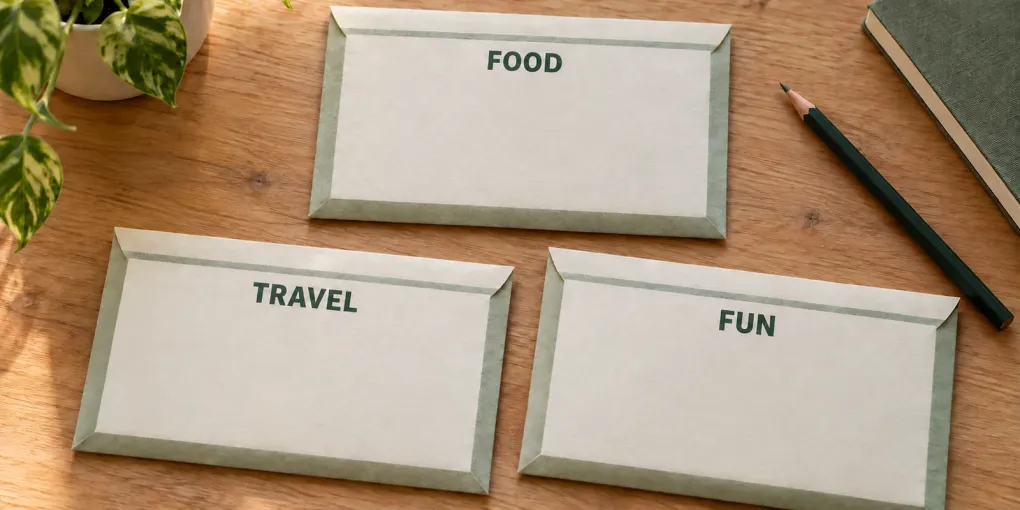
Cash stuffing means dividing your spending money among labeled envelopes, then using each envelope for its assigned category. Start with a few everyday expenses, such as groceries and dining out, and fund them from money you actually have. The purpose is to make a spending limit visible; the method does not create extra income or guarantee savings.
You do not need to withdraw your whole paycheck or buy a special binder. Keep money for account payments in the bank, decide what you can afford to spend in cash, and record purchases as they happen. A budget worksheet helps plan the full period; printable cash envelopes hold the cash and a handwritten record.
Updated 2026-10-20.
What is cash stuffing, and what stays in the bank?
Cash stuffing is the physical-cash version of envelope budgeting. You give money a purpose before spending it. A category can be broad, such as household supplies, or narrow, such as lunches at work.
Fidelity describes the method as particularly suited to variable expenses that can readily be paid in cash. Its guide also notes that online payments need a separate arrangement. Read Fidelity’s explanation.
Use a simple division:
- Cash envelopes: selected purchases you expect to make in person.
- Money held in your account: scheduled bills, card payments and purchases you expect to make online.
- Savings allocations: amounts set aside for future needs, recorded separately from spending.
An envelope label describes a purpose, not necessarily a storage location. A paper marked “car repairs: $120 held in savings” can remind you of that allocation without containing $120 in notes. Do not add the paper amount to the account amount when totaling your money: they represent the same funds.
Set up cash stuffing around your next payday
Choose the period before choosing the amounts. If you are paid every two weeks, begin with the next two weeks rather than assuming each paycheck covers exactly half a calendar month.
- Check available money. Use income already received and any usable opening balance. Exclude money already committed to another purpose.
- List bills and due dates. Include payments due before the next payday and money you need to reserve toward later bills.
- Review actual spending. Look at recent receipts and account records for the categories you want to manage.
- Set category amounts. Leave room for essential costs and planned savings before allocating optional spending.
- Choose the cash portion. Withdraw only what your selected envelopes need. Account for any withdrawal fee.
- Write the refill date. Review the plan at that point, rather than repeatedly withdrawing more whenever cash runs low.
The CFPB’s cash-flow budget worksheet focuses on the timing of income and expenses and carries each week’s ending balance into the next week. That timing matters even when a monthly total appears affordable.
If income varies, fund the next essential commitments from money already available. An expected payment can go in a note; do not spend it as if it has arrived.
Choose cash stuffing categories you will actually use
Begin with three or four categories you can keep distinct. Add more only when doing so answers a useful question about your spending.
| Category | What belongs here | Practical boundary |
|---|---|---|
| Groceries | Food for meals at home | Decide whether toiletries belong here or in household supplies |
| Dining out | Takeout, cafés and restaurant meals | Include tips and delivery charges when relevant |
| Household | Cleaning products and everyday supplies | Separate large planned replacements |
| Personal spending | Small purchases each person chooses | Give each person a clear allowance if sharing a budget |
| Transport | Cash fares or other cash purchases | Keep app fares and account payments in the bank portion |
| Gifts | An amount reserved toward planned gifts | Carry the balance forward until needed |
Avoid a vague “other” envelope that absorbs every surprise. If the same expense appears repeatedly, give it a category or revise an existing one.
Decide how to split mixed receipts. If a store receipt contains $42 of food and $8 of cleaning products, record $42 against groceries and $8 against household supplies. The total expense is $50. Keeping the receipt makes that split easier to check later.
A cash stuffing budget: one $1,500 paycheck
This fictional two-week example shows the arithmetic, not recommended spending levels. Assume $1,500 has arrived and there is no opening balance to include.
| Allocation for this period | Cash | Held in accounts | Total |
|---|---|---|---|
| Housing payment | $0 | $700 | $700 |
| Utilities and phone | $0 | $120 | $120 |
| Required payment on existing debt | $0 | $80 | $80 |
| Groceries | $180 | $60 | $240 |
| Dining out | $50 | $0 | $50 |
| Household supplies | $30 | $0 | $30 |
| Transport paid by card | $0 | $80 | $80 |
| Planned savings | $0 | $150 | $150 |
| Account cushion | $0 | $50 | $50 |
| Total | $260 | $1,240 | $1,500 |
The checks are:
Bills $900 + everyday spending $400 + savings $150 + cushion $50 = $1,500.
Cash $260 + money held in accounts $1,240 = $1,500.
Only $260 is withdrawn. The $60 grocery allocation in the bank is already part of the $240 grocery budget. It is not another $60 to add on top.
To recreate the plan in the budget planner, enter the $900 of bills once across Fixed Expenses and Bills, the $400 of everyday spending under Variable Expenses, and $150 under Savings Goals. With income of $1,500, the displayed remaining amount is $50. Write “Keep $50 as account cushion” in Notes.
Use entries such as Groceries | 240. Do not add a separate $260 “cash withdrawal” expense: moving money from your account to your envelopes changes its location, not its purpose or how much you have spent.
Combine cash stuffing with card payments without double counting
For a mixed category, track three figures: cash available, account money allocated, and total category balance. The bank’s overall balance includes other commitments, so it is not the amount available for groceries.
Using the $240 grocery category above:
| Event | Grocery cash | Grocery money in account | Grocery budget remaining |
|---|---|---|---|
| Start of period | $180 | $60 | $240 |
| Buy $45 of groceries with cash | $135 | $60 | $195 |
| Buy $30 of groceries with a debit card | $135 | $30 | $165 |
You spent $75, leaving $165 for groceries. The debit purchase reduces the bank portion; the cash envelope still correctly contains $135. Write the $30 purchase once in the grocery category record and mark it “debit.”
Use the printed envelope’s front ledger for the physical cash balance. Keep the bank portion and combined category total on a separate sheet, clearly headed “Groceries: cash + account.” Mixing those two meanings of “balance” in one column makes reconciliation difficult.
For a credit card purchase, record the category expense when you buy the item and reserve the matching money for paying the card. Paying off that same purchase later moves the reserved money to the card; it is not a second grocery expense. Payments toward debt from before this plan remain a separate budget commitment, as in the example above.
If the next online order exceeds the category’s bank portion, rearrange the funding before buying it. Do not assume money reserved for rent is spare simply because it is visible in the same account.
When an envelope runs out or has money left
Cash stuffing needs a rule for both situations. Decide it before the first shopping trip.
An optional category runs out: pause those purchases until the refill date. If the limit repeatedly fails, review the category and the whole budget together.
An essential category is short: revise the plan. For example, moving $15 from dining out to groceries reduces dining out by $15 and increases groceries by $15. Record both sides as a transfer. Your total money and total spending do not change.
All categories are short: moving money between envelopes cannot solve a total shortfall. Recheck upcoming commitments and reduce or postpone optional spending where possible. Do not skip essential food or medicine just to preserve an envelope rule.
Money remains: choose one of these approaches and write it down:
| Rollover rule | Example with $20 left in groceries |
|---|---|
| Top up to the usual limit | Add $160 to restore a $180 cash limit |
| Carry forward and add the full new allowance | Add $180, making $200 available; plan for that higher limit |
| Move the leftover to a savings goal | Record the $20 transfer, then fund the new grocery period separately |
The $20 carryover is existing money, not new income. If you move it to savings, count that contribution once. Do not describe it both as money saved by underspending and as another separate deposit.
Print and assemble your first cash stuffing envelopes
The cash envelope generator produces one foldable envelope per A4 or US Letter sheet, with six blank rows for handwritten dates, money in, money out and balances.
- Choose a banknote-size preset: USD, EUR, BRL, CNY, JPY or KRW.
- Enter the category, optional budget text and period. Choose a color.
- Select A4 or US Letter to match the paper in your printer.
- Download PDF or PNG, or print directly. Save the export before refreshing or closing the tab.
- Print at Actual size / 100% and measure the 50 mm calibration line. Avoid “Fit to page,” which can shrink the pocket.
- Cut the outside outline, fold the dashed lines and glue the bottom panel to the side tabs. Keep the pocket and top opening free of glue.
Test one assembled envelope with your notes before making the set. These are paper pockets for a small stack of notes, not coin holders or a guaranteed fit for a particular binder.
The six currency presets change the envelope dimensions; they do not convert money. Budget and period fields are printed text. The ledger does not calculate balances, record transactions automatically, synchronize with a bank or save your settings after the page session. When six rows are full, continue on a separate ledger or print another envelope and transfer the closing balance.
Cash stuffing advantages and drawbacks
| Potential advantage | Limitation to plan for |
|---|---|
| A visible amount remains for each cash category | Cash purchases still need handwritten records |
| A pause before spending beyond a category | You can bypass the limit with a card unless the records stay connected |
| Ordinary envelopes are enough to begin | Withdrawals, counting and reconciliation take time |
| Useful for selected in-person purchases | Online and card-only purchases need account allocations |
Cash stored at home can be lost, stolen or destroyed. The CFPB discusses those risks and recommends choosing an emergency-fund location that is safe and accessible. See its emergency-fund guidance.
In the United States, FDIC insurance covers eligible deposits at FDIC-insured banks; it does not cover cash in your home envelopes. Check the FDIC’s coverage explanation.
Cash in an envelope also earns no account interest. Fidelity notes that money can instead stay in an interest-bearing account while you track its purpose on paper. See its discussion of trade-offs. There is no need to bring all your savings into a cash system.
Cash stuffing: common questions
How much money do I need to start cash stuffing?
There is no required starting amount. You can test one category using money already allocated to it. For example, put a planned $20 of personal spending in an envelope; this is organizing $20 you have, not finding an extra $20 to save.
Can I do cash stuffing if most payments are by card?
Yes, with a hybrid arrangement. Keep category allocations in the bank for card purchases, use cash only where practical, and update one combined category record. A fully digital version uses the same category-limit principle without physical envelopes.
Is this the same as the 100-envelope savings challenge?
No. Cash stuffing manages spending categories. A 100-envelope challenge organizes savings contributions by numbered amounts. You can use both, but each savings contribution must come from money your budget leaves available. See the savings challenge comparison before choosing a target.
How do two people share cash envelopes?
Agree on the categories, who carries which cash and where both people record purchases. Split the cash between two labeled wallets if useful, but keep one category total. A household should not accidentally give each person the full shared allowance.
What if the money in my envelope does not match the ledger?
Count the notes and any separately stored change, then check receipts, transfers and unrecorded purchases. If you cannot explain the difference, write a clearly labeled adjustment to match the money actually present. Do not invent a purchase to make the arithmetic work.
Start cash stuffing with one manageable pay period and a few clear categories. Prepare your budget worksheet, then print your first cash envelopes and record the opening balances before spending.