Printable Guide
Money Saving Challenges: Find a Plan You Can Afford
Compare money saving challenges: 100 envelopes, 52 weeks, a no-spend month and fixed goals. Check the totals, adapt your plan and print a free tracker.
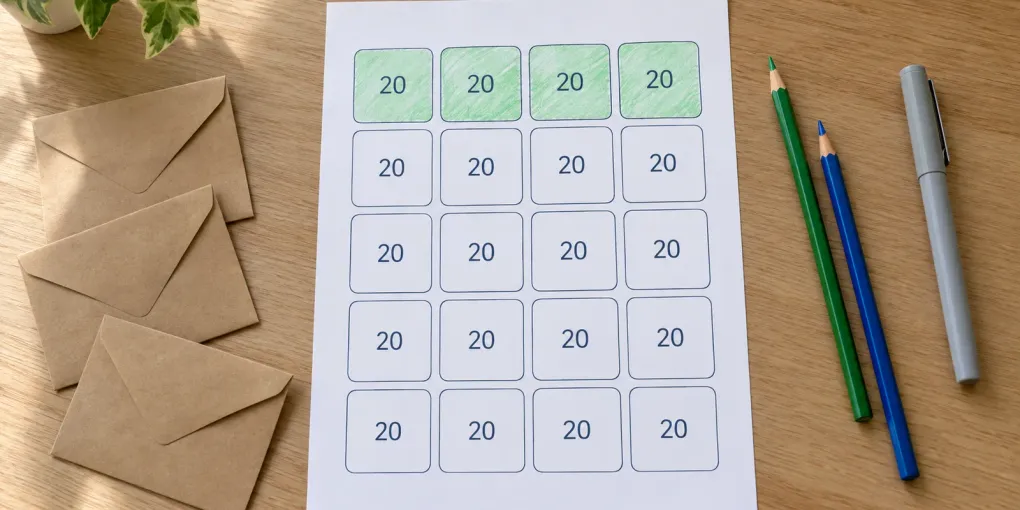
The best money saving challenges fit the money you can actually spare. Choose a fixed amount if you need predictable deposits, 52 weeks if increasing contributions suit your income, 100 envelopes if you want flexible amounts, or a no-spend month if you want to review optional purchases. None requires buying a binder or keeping cash at home.
With a base amount of $1, the classic 100-envelope challenge totals $5,050, while the 52-week challenge totals $1,378, before interest. Those totals are possible contributions, not recommendations for your budget. Check the largest deposits before choosing a plan, then use a free printable savings tracker to record what you really set aside.
Updated October 20, 2026.
Compare four money saving challenges
Use the table to choose a starting point. Here, b means your base amount in your chosen currency: $1, £0.50 or another affordable amount.
| Challenge | What you do | Total contributions | Main affordability check |
|---|---|---|---|
| 100 envelopes | Complete deposits numbered 1–100, each multiplied by b | 5,050 × b | Largest deposit: 100 × b; no required daily schedule |
| 52 weeks | Save b in week 1, 2b in week 2, through 52b | 1,378 × b | Last four deposits together: 202 × b |
| No-spend month | Pause chosen optional purchases while paying essential costs | No fixed total | Count only money actually left available and set aside |
| Fixed target | Divide a chosen goal into manageable deposits | Your target | Deposit amount and deadline must both fit your budget |
Choose by your tightest ordinary pay period. Write down take-home income, bills due before the next payday, groceries, transport, required debt payments and other committed spending. Allow for known irregular costs, such as an annual insurance bill. The amount left is a starting point for deciding whether a contribution is manageable.
The CFPB explains that a suitable emergency-savings target depends on your circumstances and that even small amounts can help. Its guidance also highlights the timing of income and expenses, which matters when your monthly budget looks fine but a transfer falls just before rent. Read the CFPB’s emergency-fund guide.
If nothing is available this pay period, begin with a spending review and revisit the target later. Borrowing or missing a bill to color a box defeats the purpose.
The 100-envelope challenge: 100 deposits, at your pace
Number the deposits from 1 to 100. Each number tells you how much to save after multiplying it by your base amount. With a $1 base, cell 37 represents $37. Completing every number once gives:
(1 + 2 + … + 100) × b = 5,050 × b
The familiar daily version finishes in 100 days. However, you can choose a slower schedule. Fidelity describes changing the frequency or amounts to suit your finances, including using transfers instead of cash. See Fidelity’s challenge overview.
For a gentler version, set the base to $0.10. Deposits then range from $0.10 to $10, totaling $505. A $0.50 base ranges from $0.50 to $50 and totals $2,525.
Choosing small numbers first makes the beginning easier but leaves larger amounts for later. To keep contributions more predictable, pair low and high numbers: 1 + 100, 2 + 99, and so on. Each pair costs 101 × b, with 50 pairs in total. At a $0.10 base, that is $10.10 per pair.
Before committing, test one pair against a normal paycheck. If even that is too much, lower the base or use a smaller fixed target. Random selection is optional; it should never decide how much you must take away from essential spending.
The printable is a grid for tracking deposits. It does not create envelopes, and you do not need to buy any.
The 52-week challenge: check the final four weeks
The classic weekly schedule starts with one base unit and increases by that unit each week:
(1 + 2 + … + 52) × b = 1,378 × b
The easy beginning can hide an expensive finish. Weeks 49–52 require 49b + 50b + 51b + 52b = 202b. With a $1 base, those four deposits total $202. With a £0.50 base, they total £101, and the full challenge totals £689.
These are the final four challenge weeks, not necessarily a calendar month. Starting in October does not make week 52 fall in December.
Three practical schedules are possible:
- Ascending: follow 1b through 52b if the later payments are affordable.
- Descending: begin with 52b and work downward if you have more spare money now. Cross off the matching printed cell.
- Flexible order: choose an affordable unused amount each week and write the date beside it.
All three reach the same total only if you eventually complete every amount once.
If a changing weekly payment feels unnecessary, $26.50 every week for 52 weeks also equals $1,378. Fidelity gives this fixed-transfer alternative in its 52-week explanation. Keep a simple transfer log for that version: the PrintMigo 52-week preset prints increasing amounts, and its custom-goal mode does not offer 52 equal cells.
An automated transfer, if you choose one, is set up through your financial provider. Check the date against incoming pay and upcoming bills.
A no-spend month: define the rules and count real savings
A no-spend month pauses selected optional purchases. Keep paying for essentials such as housing, food, transport, utilities and health care. Fidelity recommends reviewing previous spending, defining essential versus optional purchases, and choosing a duration you can manage. Read its no-spend guide.
Write the rules before the first day:
| Keep paying | Pause or limit | Decide in advance |
|---|---|---|
| Rent, utilities and required payments | Unplanned clothing and accessories | Previously arranged celebrations |
| Basic groceries and necessary transport | Takeout and convenience purchases you choose to replace | Work-related purchases |
| Medicine and other health needs | Optional subscriptions you can cancel | Repairs and replacement essentials |
Adapt those examples to your household. A work lunch, for example, is not automatically optional if you lack a practical alternative.
Start with a week if a month feels unrealistic. Use a separate spending log with three columns: date, purchase avoided and actual replacement cost. A useful copyable rule is:
“From October 21 to November 20, I will pause unplanned clothing purchases. Essential replacements are allowed. I will check my available balance each payday before moving money to savings.”
Here is an illustrative calculation: you budgeted $120 for takeout, spent $20 on one planned meal and spent an additional $35 on replacement groceries. The possible difference is $120 − $20 − $35 = $65. Count $65 toward the goal only if it remains available after other commitments and you actually set it aside.
Do not count a canceled $80 shopping cart if you never budgeted or had $80 to spend. A purchase postponed until next month also does not automatically create lasting savings. Review the following month’s spending before declaring the experiment a success.
Fixed-target money saving challenges and currency choices
A fixed target is useful when the goal matters more than completing a familiar grid. Start with the amount still needed, then divide it by the number of contributions you can realistically make. The CFPB’s savings-plan worksheet uses this goal-and-time approach and places the resulting savings amount into the household’s cash-flow budget.
For example, a $600 goal over 20 contributions requires $30 each time. If you save every two weeks, 20 contributions take about 40 weeks; 20 boxes do not mean 20 weeks automatically.
The PrintMigo savings tracker divides a custom target across 10, 20, 25, 50 or 100 cells. When the amount does not divide evenly, the first cells receive one additional smallest currency unit:
- $100 across 25 cells: $4 per cell.
- $100 across 20 cells: $5 per cell.
- $100.01 across 20 cells: one cell of $5.01 and 19 cells of $5.
You can select USD, EUR, GBP, CNY, JPY, KRW, BRL, MXN, CAD or AUD. Changing currency does not convert the amount. Switching a target from USD 600 to EUR changes its denomination to EUR 600; no exchange rate is applied.
For perspective, a base of £1 produces £5,050 across 100 envelopes and £1,378 across 52 weeks, just as a €1 base produces €5,050 and €1,378. Equal numbers do not imply equal buying power. Yen and won use whole units in the tool; the other listed currencies use two decimal places.
Adjust money saving challenges when life interrupts
A missed contribution is information about your plan. Keep the amount already saved and adjust what remains.
| What changed? | Practical adjustment |
|---|---|
| You missed one contribution | Leave its cell blank and resume when affordable; extend the finish date |
| Income is lower for several weeks | Reduce the future target or pause deposits |
| Larger numbered cells are unaffordable | Switch to a fixed target based on money still available |
| You need part of the savings | Record the withdrawal and revise the remaining balance |
| A bonus or gift arrives | Add only the portion available after your other priorities |
Suppose you planned $600 and still hold $180 toward that goal. You need $420 more, not another $600. A new 20-cell sheet can represent $21 per cell. Write “$180 already saved; this sheet adds $420” on the paper so the two records stay distinct.
If you withdraw $60 before restarting, the retained amount is $120 and the remaining target becomes $480. Use the balance that actually remains, rather than the number of boxes previously colored.
Combining challenges needs the same care. If $30 saved during a no-spend week funds one $30 goal cell, your contribution is $30 total. It is not $60 because two challenges describe it.
Track money saving challenges with a printable sheet
Use the sheet as a visible record beside your account or cash records:
- Open the free savings tracker generator and choose 100 envelopes, 52 weeks or a custom goal.
- Enter the goal name, currency and base amount or target. Check the largest cell and total in the preview.
- Choose A4 or US Letter to match your paper, then select portrait or landscape and a design.
- Download PDF or PNG, or print directly. Keep the export before leaving or refreshing the page.
- After setting aside a deposit, color the corresponding cell by hand. Add the date if it helps you reconcile the sheet.
The PDF is a flat image, not a fillable form. The site does not save online progress, connect to a bank, move money, verify deposits, calculate interest or perform currency conversion. The 100-envelope sheet records amounts; the weekly sheet records 52 increasing contributions.
There is no dedicated no-spend calendar preset. Keep your purchase rules and spending log separately, then use a custom-goal sheet to track money you actually save.
Cash is optional. Bank of America’s challenge guide describes transferring the numbered amounts into savings instead of filling physical envelopes. Mark the paper after the transfer completes. If you use cash, count it periodically so the sheet matches what remains.
Money saving challenges: common questions
Which money saving challenges work with a small budget?
Start with the amount you can spare. A $100 target across 20 cells gives $5 contributions, while a $0.10 base reduces the 100-envelope total to $505. Neither amount is compulsory. If there is no spare money, review spending and bills first.
Can money saving challenges help me save $1,000?
Yes, if the contributions fit your finances. A custom $1,000 goal divided across 50 cells gives $20 per cell. Saving $20 weekly takes 50 contributions; saving it every two weeks takes about 100 weeks. Interest is not included.
Do money saving challenges require a new bank account?
No. The tracker needs no account or signup. How you hold the money is separate: use a clearly recorded allocation or a suitable savings arrangement, and check any account conditions before changing financial products.
Can I start after January or miss a week?
Yes. Start when the next affordable contribution is available. Date the paper yourself and leave missed cells blank. A delayed finish with accurate records is more useful than marking contributions you have not made.
Can I color a cell when I only save part of its amount?
Write the partial amount beside the cell and finish coloring when the full printed amount has been set aside. For frequent partial deposits, switch to smaller custom-goal cells so each completed box has a clear meaning.
Choose one of these money saving challenges, check its hardest contribution, and make the first deposit small enough to repeat. Create your printable savings tracker and color the first cell after the money is saved.