Printable Guide
Age Appropriate Chores: A Practical Guide for Ages 2–12
Choose age appropriate chores for ages 2–12, plan a manageable week, compare allowance options, and make a free printable chart with pictures for kids.
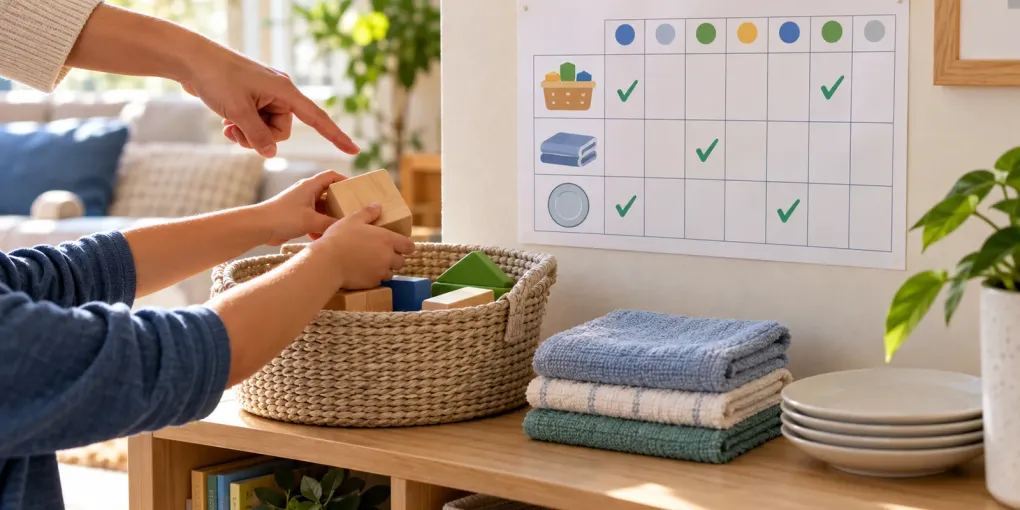
Age appropriate chores start with small jobs a child can do safely with the help available: toddlers can put a few toys into a basket beside an adult; preschoolers can carry napkins; school-age children can learn table, laundry, and cleaning tasks; older children can practise longer jobs with supervision. Use age as a starting point, then adjust for experience, ability, equipment, and your home.
Allowance is optional. You can keep it separate from household jobs, pay for agreed tasks, or combine unpaid family contributions with paid extras. The American Academy of Pediatrics’ advice on children and money leaves this choice to families. Start with a manageable task, teach it, and decide how you will acknowledge completion before building a long chart.
Updated October 20, 2026 (2026-10-20).
Age Appropriate Chores: A Quick Chart for Ages 2–12
Choose from this menu; a child does not need to do every task in their row. The examples for younger children draw on Cleveland Clinic’s pediatric guidance. The school-age bands follow the AAP’s chore suggestions. The adult-help column makes the scope of each suggested job clear.
| Age | Tasks to try | Adult help and a clear stopping point |
|---|---|---|
| 2–3 | Put toys in a basket; return books to a low shelf; carry an empty, unbreakable cup | Work together. Name one object and its destination; offer the next instruction after that step. |
| 4–5 | Straighten a blanket; bring napkins to the table; water a plant with a small cup | Demonstrate and stay nearby. Prepare a small quantity of water and handle heavy or breakable items. |
| 5–7 | Make a simple bed; sort laundry; dust a reachable shelf; sweep a small area | Teach the task and check the result. “Sweep crumbs under this chair” is clearer than “clean the floor.” |
| 8–10 | Put away clean clothes; vacuum an open area; put away light groceries; help prepare a snack | Show safe equipment use. Adults handle heavy loads, sharp tools, and hot items. |
| 11–12 | Change sheets; fold laundry; unload safe dishwasher items; help cook a simple meal | Teach the sequence. Keep an adult present for cooking; remove knives and fragile items before unloading. |
The overlapping age bands are intentional: a five-year-old may be learning either set of tasks. An older child starting from scratch may also need the simplest version.
A kids chore chart with pictures can turn two selected jobs into visible reminders. Remove preset chores that do not fit your child.
How to Choose Age Appropriate Chores for Your Home
Before assigning a job, walk through it yourself and ask:
- Can my child reach and carry what it requires? Move the supplies or choose a smaller load.
- Have I shown the actual steps? Knowing what clean laundry looks like does not teach where each item belongs.
- Is the necessary help available at that time? A supervised cooking job belongs on an evening when an adult can stay beside them.
- Can we both describe when it is finished? Replace “tidy up” with “put the cars in their box.”
Keep the expected result functional. A blanket can be straight enough to sleep under without looking like a hotel bed. A drawer can hold the correct clothes without perfect folds.
For children who find a task difficult, change one part: offer a lighter basket, fewer items, a seated work surface, or a picture beside the drawer. Ask which part is hard before adding another reminder. These are practical adjustments to try, not a requirement to reach a particular skill by a birthday.
Check hazards separately
Being old enough for a job does not make every version safe. For this starter plan, leave chemical cleaning, power equipment, ladders, and sharp or hot objects with adults. Laundry can mean sorting or folding without handling detergent. The AAP’s laundry safety guidance specifically says children should not handle detergent packets.
Pet care needs an adult’s judgment about the animal and the task. A child can help with a prepared food portion while an adult remains responsible for feeding. Caring for a younger sibling is also a separate responsibility: the AAP’s example for ages 11–12 explicitly keeps an adult at home.
Teach the Job Before Expecting a Finished Result
A printable checklist records an agreement; it cannot demonstrate a new skill. Try this teaching sequence with one new job:
- Show it: Place three folded shirts into the correct drawer while your child watches.
- Share it: You identify the drawer; they carry one shirt.
- Let them lead: Ask them to put away the remaining shirts while you stay available.
- Check together: Look for the agreed result and name something specific they did.
Useful wording might be: “The shirts are in your drawer, so that job is finished. Thank you.” If something needs fixing, keep the instruction equally concrete: “These two socks belong in the other drawer.”
Give the task a predictable place in the day, such as returning books before the evening story. The AAP recommends consistency and recognizing effort while children learn. Avoid assigning a new job during the busiest departure of the week.
Use chart wording that includes the object and action. “Put napkins by each plate” gives a child more direction than “Dinner help.” If the wording needs several sentences, practise a smaller part first.
A Sample Week of Age Appropriate Chores
Here is an example for a family with children aged four, seven, and eleven. It is a starter plan to adapt, not a recommended daily quota. Each child keeps one familiar daily job and practises a small additional contribution on selected days.
Daily anchors: the four-year-old returns toys with an adult after play; the seven-year-old clears their own unbreakable dishes after dinner; the eleven-year-old puts dirty clothes in the hamper before bed.
| Day | Age 4, with adult help | Age 7, after demonstration | Age 11, with help as needed |
|---|---|---|---|
| Monday | Daily job only | Daily job only | Daily job only |
| Tuesday | Put out napkins | Sort a small laundry pile | Put away clean clothes |
| Wednesday | Daily job only | Daily job only | Daily job only |
| Thursday | Water one plant together | Sweep crumbs under the table | Help make a cold side dish |
| Friday | Daily job only | Daily job only | Daily job only |
| Saturday | Return books to a low shelf | Fold hand towels together | Change a pillowcase and help with sheets |
| Sunday | Choose next week’s picture | Say which task needs help | Review the plan with an adult |
Count the familiar job as real participation on quieter days. A missed Tuesday does not need to become three extra jobs on Wednesday. Reschedule necessary work and decide who will do it.
On a weekly chart, include the day in an occasional task’s label, such as “Saturday: fold towels,” and cross out unused boxes after printing. This prevents a weekly job from looking like a daily obligation. Use the family chore chart maker to assign each row to the correct person.
Should Children Be Paid for Age Appropriate Chores?
Decide what you want the money arrangement to accomplish and explain it before the week begins. These are three possible family arrangements, rather than a ranking of parenting methods:
| Arrangement | How it works | What to make clear |
|---|---|---|
| Allowance separate from chores | A regular amount provides money to practise managing; household jobs are agreed separately | What the allowance covers and how unfinished chores will be addressed |
| Payment for agreed chores | Named jobs have a stated payment when completed | The task, finish point, amount, review day, and what happens when help is needed |
| Family jobs plus paid extras | Regular contributions are unpaid; selected additional jobs can earn money | Which jobs belong in each group, before anyone starts |
You can also choose no allowance and acknowledge participation through thanks, a completion mark, or choosing a shared activity. Set any optional reward at a level your household can sustain.
There is no universal payment amount in this guide. Start with your budget and the small discretionary purchases your child will manage. A template’s sample amounts are editable examples, not recommended rates. State the currency and whether a value applies once per week or each time a job is done.
A copyable family agreement:
We all help with the daily jobs on our chart. Extra paid jobs are optional and must be agreed first. We write down the job, amount, and finish point before starting. We review completed jobs together on Sunday. Ask for help whenever a step feels unsafe or unclear.
Money practice needs conversation as well as payment. The Consumer Financial Protection Bureau’s guidance for ages 6–12 includes discussing earning, saving, planning, and comparing purchases. At review time, ask what your child wants to save for and what spending choice they made.
Turn Age Appropriate Chores into a Printable Chart
The picture chore chart for kids is useful for a short individual list. The general chore chart maker also offers family, rotating, money, and points templates.
- Choose a starting template. The toddler and picture templates include icons; delete tasks you are not using.
- Add names and specific jobs. The maker supports up to six people and twelve chores in a weekly chart. That is its capacity, not a target.
- Check the pictures. Use an icon that your child understands and explain it together. You can change the icon beside a task.
- Choose the week and markers. Select seven days or Monday–Friday, the week start, and checkboxes, stars, circles, or smile faces.
- Decide about values. Leave the value column off, or use money or points. Add your agreement in the notes.
- Download and print. Choose US Letter or A4 to match your paper, then download the PDF or PNG, or print directly.
Check the print preview for clipping. If the printer requires scaling to keep the border visible, a slightly smaller chore chart is still usable; there are no cutting dimensions to preserve.
Completion marks and totals are filled in by hand. The maker prints the values you enter and leaves total spaces blank. It does not calculate earnings or record completed chores. Save your finished PDF before closing the page, and print a new version when the plan changes.
Fix the Plan When It Becomes Hard to Follow
| What happens | A change to try this week |
|---|---|
| “They forget every day.” | Put the chart where the job starts and connect it to an existing routine. |
| “They stop halfway.” | Ask which step is unclear; split the job into two smaller actions. |
| “It takes the whole evening.” | Reduce the area or number of items and practise the difficult step together. |
| “Siblings say it is unfair.” | Compare time, difficulty, and support rather than the number of ticks. |
| “Nobody uses the chart.” | Remove decorative rules or reward calculations that take more effort than the chores. |
For families with different schedules, rotate only jobs that everyone involved can safely do. A toddler and an eleven-year-old should not automatically exchange every task.
If everyday tasks remain unusually difficult across both home and school despite support, the AAP suggests discussing your concerns with your child’s pediatrician. A chart can reveal where help is needed; it cannot explain the cause.
Questions Parents Ask About Age Appropriate Chores
What chores can a two-year-old do?
Start together with a concrete action such as returning one book or putting a toy in a basket. Stay beside them, choose safe objects, and expect to finish together. A full independent cleanup is a different task.
How many chores should a child have each day?
There is no number that fits every child or household. Start with a small repeatable contribution and check whether it fits alongside school, sleep, play, and support needs. Add work when the existing arrangement feels manageable.
Should a seven-year-old do the same chores as an older sibling?
They can contribute to the same job at different levels: one sorts towels while the other folds them. Agree on each child’s part and keep adults responsible for any hazardous steps.
Can a chore chart work without money or rewards?
You can use it simply as a shared reminder of who does what. Leave the money and reward sections off, mark completed tasks together, and adjust any job that is unclear.
Choose age appropriate chores that your child can practise this week, then make a free printable chore chart with the names, pictures, and expectations your family actually needs.